
William M. Brown v. Terravita Country Club: When an Arizona HOA Records Win Moves to Superior Court

Arizona HOA Records • A.R.S. § 33-1805 • Superior Court Enforcement

Brown shows what can happen after a homeowner wins an Arizona HOA records case at ADRE/OAH and then asks the Superior Court to enforce the order: the court can narrow the dispute to exactly what remains missing, treat later production as compliance, and still deny the association fees.

Last updated May 16, 2026. Case: William M. Brown v. Terravita Country Club, Inc., et al., Maricopa County Superior Court No. CV2017-055475; final minute entry June 4, 2018; Hon. John R. Hannah Jr.

Current-status note: Pipeline note: the public raw-source folder contains source files that were not in the last staged NotebookLM source set. The page remains a source-linked record, but generated media should be rebuilt or rechecked after the staged source manifest catches up.

Allegations, settlements, procedural dismissals, and notices are not findings of liability unless a cited court order expressly makes that finding.

Scope note: This page covers a Maricopa County Superior Court enforcement case tied to Arizona planned-community records requests under A.R.S. § 33-1805. It is a trial-court record, not a published appellate precedent. It is educational and is not legal advice.

The rule in one sentence

Winning an Arizona HOA records order at ADRE/OAH may create a path to Superior Court enforcement, but the court can require a precise missing-records showing and may dismiss the enforcement request if later productions satisfy the administrative order.

Case snapshot

Case name

William M. Brown v. Terravita Country Club, Inc., et al.

Court and docket

Maricopa County Superior Court No. CV2017-055475.

Final order

June 4, 2018 minute entry by Hon. John R. Hannah Jr.

Core statute

A.R.S. § 33-1805, Arizona planned-community association records.

Case Dossier

This dossier combines the case metadata, linked court sources, and the explanatory sections below. It distinguishes court rulings from party filings, allegations, and requested relief.

Case Summary

Case ID / citationCV2017-055475
Court / tribunalSuperior Court
Decision / key dateJune 4, 2018
Judge / panelHon. John R. Hannah Jr.
PartiesA homeowner asked the Maricopa County Superior Court to enforce an ADRE/OAH records-order win against Terravita Country Club, Inc. and related defendants.
Governing law
Topics
Records RequestsProcedureBoard GovernanceAttorney Fees
Outcome / holding

The superior court found Terravita had complied with the administrative records order, dismissed the application for an order to show cause with prejudice, and denied the defendants' request for fees and costs.

Primary public sourceView source opinion/order

Parties, Court, and Research Coverage

Reviewed source package51 PDFs, 3 other source files
Step-by-step docket roadmap21 roadmap entries
Video overviewWilliam M. Brown v. Terravita Country Club, Inc.
Study / briefing material1 section
FAQ / homeowner questions5 questions
Featured download links3 download links

Key Issues & Findings

Case Summary

William M. Brown filed a Maricopa County Superior Court action after winning an administrative records-request order against Terravita Country Club, Inc. The case asked the court to force compliance with an ADRE/OAH order arising from A.R.S. § 33-1805. The court first required Brown to identify exactly what remained unproduced, then reviewed the later production history. On January 31, 2018, the court dismissed the individual board-director defendants and the attorney defendants, and denied transfer of a related civil case. On June 4, 2018, the court found Terravita had complied with the administrative order, dismissed the order-to-show-cause application with prejudice, and denied defendants' fees and costs.

Key Issues & Findings

Judge Hannah focused the enforcement case on what the administrative order required and what remained missing. After the October 27, 2017 status conference, Brown was ordered to specify precisely which records he still claimed had not been produced and why the omission violated the administrative law judge's order. The court later concluded that the October 27 production, earlier production at the time of the July ALJ order, and information forwarded through Terravita's attorney together supplied a complete and coherent response. The court also ruled that the director defendants did not owe fiduciary duties directly to Brown individually, and that the attorney defendants were not liable where the complaint did not allege wrongdoing or a duty to Brown as an opposing party.

Why It Matters

The case is a practical example of both the power and limits of taking an Arizona HOA records win from ADRE/OAH into superior court. A homeowner can seek judicial enforcement after an association loses an A.R.S. § 33-1805 records case, but the court may require a precise missing-records showing and may treat later production as compliance. The case also warns against overnaming individual directors and opposing counsel unless the pleadings identify a viable duty and conduct. For boards, the fee ruling is also notable: even after dismissal, the court declined fees because some responsive documents may have been produced only after suit was filed.

Case Participants

Petitioner Side

  • William M. Brown (Plaintiff)
    Homeowner who sought Superior Court enforcement of the records order.

Respondent Side

  • Terravita Country Club, Inc. (Defendant)
    Association party in Brown’s Superior Court enforcement action.
  • Joshua M. Bolen (Counsel)
    Terravita Country Club
    Appeared for Terravita at the order-to-show-cause hearing.

Neutral Parties

  • John R. Hannah Jr. (Judge)
    Superior Court judge presiding over the enforcement case.

Why this case matters

Brown is useful because it shows the second stage of an Arizona HOA records fight. The homeowner had already won administrative relief in an ADRE/OAH records case. The Superior Court case was about enforcing that win after Brown alleged Terravita had not fully complied.

The case did not end with new penalties against the association. It ended with a compliance finding for Terravita, dismissal of the order-to-show-cause application with prejudice, and denial of the defendants’ request for fees and costs.

That mix is the practical lesson. A records requester may be able to use court enforcement, but the court will focus on the exact production gap, the actual production history, and whether later disclosure cured the alleged noncompliance.

Video overview of the ruling

An AI-generated video overview of William M. Brown v. Terravita Country Club, Inc. (CV2017-055475). HOA compliance with an administrative records order defeated contempt and private enforcement relief. This plain-language summary was generated from the court’s filings; the court’s own ruling controls.

Listen: audio deep dive on the ruling

An AI-generated audio deep dive walking through the court’s reasoning and disposition in William M. Brown v. Terravita Country Club, Inc.. Generated from the case filings; verify against the linked ruling below.

Audio overview generated with Google NotebookLM from the case’s court filings.

What Judge Hannah decided

1. Terravita complied with the administrative order

The court found the October 27, 2017 production, earlier production around the July ALJ order, and information forwarded through defense counsel together provided a complete and coherent response.

2. The order-to-show-cause application was dismissed

The court dismissed Brown’s application for an order to show cause with prejudice and entered judgment under Arizona Rule of Civil Procedure 54(c).

3. Director defendants were dismissed

The court ruled that fiduciary duties of HOA directors are owed to the HOA, not directly to an individual member such as Brown.

4. Attorney defendants were dismissed

The court ruled the complaint did not state a claim against the law firm or lawyers, and noted that lawyers ordinarily owe no duty to an opposing party.

5. Transfer of a related case was denied

The court denied Brown’s request to transfer related civil case CV2017-013317 to Judge Hannah.

6. Defendants did not recover fees

Even though the case was dismissed, the court denied fees and costs, noting the association arguably did not produce some responsive documents until after suit was filed.

For homeowners: using a records-order win in court

Brown shows that a homeowner can move from an ADRE/OAH records win into Superior Court enforcement, but the court may narrow the case to a document-by-document compliance question.

The strongest enforcement record identifies the administrative order, lists each still-missing record, explains why the order required that record, and tracks later production. Broad frustration with the association is less useful than a precise missing-records chart.

Suggested records-enforcement workflow

  1. Start with the ADRE/OAH order. Identify exactly what the administrative decision required the association to produce or do.
  2. Build a missing-records chart. List each requested record, what was produced, what remains missing, and why it matters under A.R.S. § 33-1805.
  3. Track later production. If the association produces records after suit is filed, update the chart rather than relying on the original gap alone.
  4. Name defendants carefully. Brown shows risk in naming individual directors or opposing counsel without a viable duty and conduct theory.

For associations and managers: compliance proof matters

Do this
  • Track each records request against each production batch.
  • Document when records were sent, by whom, and in what form.
  • Preserve explanations when a requested record does not exist or is withheld under a claimed exception.
  • Resolve compliance gaps early instead of waiting for an enforcement hearing.
Avoid this
  • Do not rely on general statements that all records were produced.
  • Do not ignore an ADRE/OAH records order after a homeowner wins administratively.
  • Do not assume late production eliminates all fee or litigation risk.
  • Do not let attorney communications obscure the basic production timeline.

How the case got to Superior Court

The Superior Court case grew out of Brown’s earlier ADRE/OAH records disputes against Terravita. In 17F-H1716005-REL, the administrative tribunal found Terravita failed to timely fulfill a records request under A.R.S. § 33-1805 and ordered compliance plus a $500 filing-fee refund. In 17F-H1717032-REL, Brown won another records-access ruling after Terravita argued the pending-litigation exception barred disclosure.

Brown then filed this Superior Court case to enforce the administrative order. The complaint named Terravita, several directors, the association law firm, and individual lawyers. The case quickly narrowed into two tracks: whether Terravita had complied with the records order, and whether the individual defendants belonged in the case at all.

At the October 27, 2017 status conference, Judge Hannah required Brown to specify precisely what records were still missing and why the failure to produce them violated the administrative order. That order became the organizing point for the rest of the case.

The records issue the court narrowed

By late October 2017, the court was no longer treating the dispute as a broad grievance about Terravita’s conduct. Judge Hannah required a document-by-document showing of what remained missing from the administrative order.

The later briefing focused on specific insurance and billing-related information tied to prior litigation, including whether certain legal fees and related expenses were covered by insurance and whether insurer communications or payments existed. Terravita responded that the responsive documents and information had been provided through the October 27 production, prior production, and counsel communications.

The final minute entry accepted Terravita’s compliance position. The court did not make a broad finding that every earlier response had been ideal; instead, it found Brown had not made a colorable showing that additional responsive information was likely to exist.

Practical lessons from the case

For homeowners enforcing records orders
  • Preserve the administrative order. The court will want to know exactly what the ALJ or agency ordered the association to produce.
  • Build a missing-records chart. Track each requested record, what was produced, when it was produced, and why anything still missing falls within the order.
  • Expect later production to matter. If the association produces records after suit is filed, the court may treat that production as compliance even if the timing was disputed.
  • Be cautious about individual defendants. Claims against directors or opposing counsel need a specific duty and specific conduct, not just their involvement in the association dispute.
For boards, managers, and counsel
  • Respond within the A.R.S. § 33-1805 deadline. The statute gives ten business days to fulfill examination requests and ten business days to provide requested copies.
  • Document every production. Keep a clean production log showing date, records produced, withheld categories, redactions, and transmission method.
  • Do not rely on vague compliance claims. A later court may need to see how each records category was answered.
  • Fee recovery is not automatic. Even after dismissal, the court denied fees where some production arguably came only after the lawsuit began.

What this case does not mean

Brown does not eliminate the administrative records remedy. The related OAH cases still show that a homeowner can prevail when an association fails to timely provide records under A.R.S. § 33-1805.

It also does not say an association may wait until a lawsuit is filed to produce records without consequence. The court denied Terravita’s fee request partly because some responsive documents arguably came after suit was filed. The narrower point is that by the time of the final ruling, the court believed the administrative order had been satisfied.

Finally, this is not a published appellate rule. It is a useful trial-court roadmap for how one Superior Court judge handled enforcement of an HOA records order on a developed production record.

Filing roadmap and PDF downloads

The raw docket package below was renamed from opaque court-download filenames into date-and-title filenames. Duplicate docket downloads are preserved and labeled rather than deleted.

Step 1 September 5, 2017

Complaint and opening order-to-show-cause package

Filed by: William M. Brown

Brown opened the superior-court enforcement case, asking the court to enforce the ADRE/OAH records order.

Step 5 October 6-16, 2017
Step 17 December 11-20, 2017

Continuance, address, and motion-to-strike filings

Filed by: William M. Brown / Defendants

The file shifted into continuance and stay-related requests before the final compliance ruling.

Step 19 January 31, 2018

Attorney defendants dismissed

Filed by: Court

The court ruled the complaint did not state a claim against the law firm or lawyers and noted lawyers ordinarily owe no duty to an opposing party.

Step 21 June 4, 2018

Final minute entry: order-to-show-cause application dismissed

Filed by: Court

The court found Terravita had complied with the administrative order, dismissed the application with prejudice, denied fees and costs, and entered Rule 54(c) judgment.

Complete source-document index

This index contains 51 PDFs, 3 other source files from the reviewed public source packet. Byte-identical copies are listed once. Files are ordered by the date and sequence in the public filename, and party filings or research materials are labeled separately from court rulings.

Source 3 2017-09-05

Civil Cover Sheet

Type: Court/source PDF

Court intake document classifying the case for filing and assignment purposes.

Source 6 2017-09-06

Rule 42 1 Change Of Judge

Type: Court/source PDF

Uploaded source file in the case record; read it in sequence with the surrounding filings to follow the procedure.

Source 8 2017-09-08

Case Reassignment To Judge Hannah

Type: Court/source PDF

Uploaded source file in the case record; read it in sequence with the surrounding filings to follow the procedure.

Source 15 2017-10-06

Return Of Service Paul Tolk

Type: Procedural/service filing

Proof-of-service material; check it to understand who was served and when deadlines started.

Source 16 2017-10-06

Return Of Service William Greig

Type: Procedural/service filing

Proof-of-service material; check it to understand who was served and when deadlines started.

Source 19 2017-10-11

Return Of Service Anjali Patel

Type: Procedural/service filing

Proof-of-service material; check it to understand who was served and when deadlines started.

Source 27 2017-10-18

Status Conference Minute Entry

Type: Court order/minute entry

Court or agency order; this is usually the document that tells readers what changed next.

Source 43 2017-12-11

Plaintiff Motion To Continue

Type: Motion/application

A request for a specific ruling or procedural action; the next document is often a response or order.

Source 44 2017-12-13

Notice Of Address Change

Type: Procedural/service filing

Procedural filing that documents service, appearance, compliance, or a required notice step.

Source 51 No docket date in filename

AI Audio The 237 Check That Paralyzed An HOA

Type: AI-generated media review asset

AI-generated review material from the upload. Use it only for orientation; verify any legal claim against the linked court filings and orders.
Source 52 No docket date in filename

AI Analysis Anatomy Of A Civil Escalation

Type: AI-generated review PDF

AI-generated review material from the upload. Use it only for orientation; verify any legal claim against the linked court filings and orders.

Source 53 No docket date in filename

AI Filing Table CV 2017 055475

Type: AI-generated source table

AI-generated review material from the upload. Use it only for orientation; verify any legal claim against the linked court filings and orders.

Download source file
Source 54 No docket date in filename

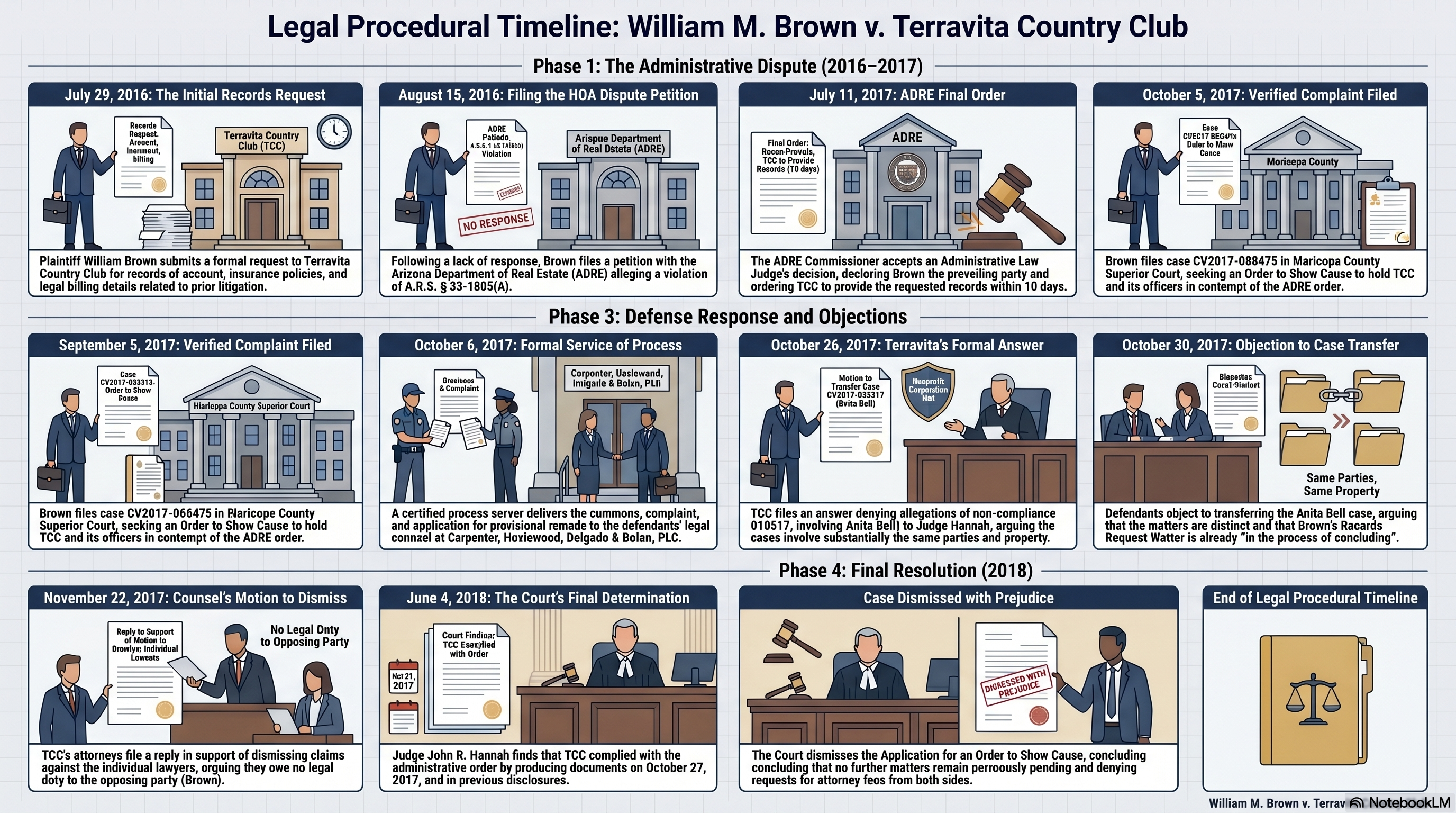
AI Generated Case Timeline Graphic

Type: Source image/graphic

AI-generated review material from the upload. Use it only for orientation; verify any legal claim against the linked court filings and orders.

Frequently asked questions

Did Brown win this Superior Court case?

No. The June 4, 2018 minute entry found Terravita had complied with the administrative order and dismissed the application for an order to show cause with prejudice.

Did Brown win the related administrative records cases?

Yes. The related OAH/ADRE records matters 17F-H1716005-REL and 17F-H1717032-REL were homeowner wins under A.R.S. § 33-1805.

Why were the individual directors dismissed?

The court ruled that fiduciary duties of HOA directors are owed to the HOA, not directly to an individual member such as Brown.

Why were the attorney defendants dismissed?

The court ruled the complaint did not state a claim against the law firm or lawyers and noted that lawyers ordinarily owe no duty to an opposing party.

Did the association recover attorney fees?

No. The court denied the defendants’ request for attorney fees and costs even though it dismissed the application, noting the timing of some responsive document production.

Primary sources

← Back to Superior Court cases

Gross v. The Shores at Rainbow Lake: Kalway, Rentals, and Occupancy Limits

Arizona HOA Rental Amendments | Kalway | 1 CA-CV 23-0394

Gross is the cleanest Arizona published rental-amendment roadmap after Kalway. The short-term lease ban was invalid, but the unrelated-person occupancy limit survived because it refined existing single-family use restrictions.

Last updated June 3, 2026. Case: Gordon Gross, et al. v. The Shores at Rainbow Lake Community Association, Arizona Court of Appeals No. 1 CA-CV 23-0394; Navajo County Superior Court No. S0900CV202200042.

Current-status note: Pipeline note: the public raw-source folder contains source files that were not in the last staged NotebookLM source set. The page remains a source-linked record, but generated media should be rebuilt or rechecked after the staged source manifest catches up.

Allegations, settlements, procedural dismissals, and notices are not findings of liability unless a cited court order expressly makes that finding.

Scope note: This page covers the published appellate opinion, amended opinion order, mandate, and uploaded trial/appellate record. The complete uploaded source-document index below is generated from the local raw source folder, including court PDFs, court DOC/DOCX notices, and AI/source CSVs where present. AI-generated CSV summaries were reviewed only as orientation and are not treated as court authority.

The rule in one sentence

Under Kalway, an HOA rental amendment can be partly invalid and partly valid: a new short-term rental ban may be unforeseeable while an occupancy limit can survive if it refines an existing single-family-use covenant.

Case snapshot

Court result

Judgment was affirmed.

Invalid part

Thirty-day minimum lease term was stricken.

Valid part

Four-unrelated-person occupancy limit survived.

Fee result

Each side bore its own appellate fees and costs.

Case Dossier

This generated dossier mirrors the structured data surfaced on the OAH/ADRE case pages. It is added from the curated court-case record and the custom page source package, while the hand-authored analysis below remains intact.

Case Summary

Case ID / citation1 CA-CV 23-0394
Court / tribunalCourt of Appeals
Decision / key dateOctober 10, 2024
Judge / panelPresiding Judge Samuel A. Thumma, Judge Jennifer B. Campbell, Judge Michael J. Brown
PartiesOwners challenged a 2021 amendment that banned short-term rentals and limited occupancy by unrelated renters in a planned community.
Governing law
Topics
CC&RsProcedureAmendmentsRental RestrictionsAttorney Fees
Outcome / holding

The court held that the new short-term rental ban was invalid under Arizona amendment-notice principles, but the cap on unrelated renters was valid because it was reasonably foreseeable from the existing CC&Rs.

Primary public sourceView source opinion/order

Parties, Court, and Research Coverage

Uploaded source package121 PDFs, 10 other source files
Step-by-step docket roadmap6 roadmap entries
Video overviewGordon Gross, et al. v. The Shores at Rainbow Lake Community Association
Study / briefing material2 sections
FAQ / homeowner questions3 questions
Curated download aliases5 download links

Key Issues & Findings

Case Summary

Gross applied Kalway in a practical, highly relevant HOA setting: rental restrictions. The community amended its CC&Rs to prohibit rentals shorter than 30 days and to bar more than four unrelated individuals from leasing a property. The Court of Appeals split the amendment. It held the short-term rental ban was invalid because it prohibited conduct the earlier CC&Rs had allowed and was not reasonably foreseeable from the original declaration. But it upheld the unrelated-persons occupancy limit because that restriction was viewed as a clarification and refinement of existing use limits rather than a brand-new burden. The opinion is one of the clearest Arizona appellate examples of how courts separate an impermissible new use restriction from a permissible refinement of an existing one.

Key Issues & Findings

The court framed the dispute as one about owner notice and reasonable expectations. A recorded declaration can be amended, but only within the fair scope of what the original declaration put buyers on notice might later be refined. Under that approach, an amendment cannot simply reverse an existing freedom and call the result a refinement.

Applying that rule, the short-term rental ban was too much because the preexisting documents had not warned owners that leasing could later be cut off in that way. The unrelated-occupants limit came out differently because the original scheme already contained structure about occupancy and residential use, making the later cap a closer fit with the bought-for framework.

Why It Matters

Gross is one of the best Arizona Court of Appeals cases for short-term-rental disputes after Kalway. It gives both sides a usable analytic framework for asking whether an amendment is genuinely foreseeable or instead a new restriction in disguise.

Boards considering rental amendments should read it before drafting. Homeowners challenging new lease limits will cite it often.

Case Participants

Petitioner Side

  • Gordon Gross (Plaintiff/Appellee)
    Owner plaintiff named in the appellate caption.
  • Liliana Gross (Plaintiff/Appellee)
    Owner plaintiff named in the appellate caption.
  • Steven A. Kernagis (Plaintiff/Appellee)
    Trustee plaintiff named in the appellate caption.
  • Sandra K. Kernagis (Plaintiff/Appellee)
    Trustee plaintiff named in the appellate caption.
  • Thomas P. Zehring (Plaintiff/Appellee)
    Trustee plaintiff named in the complaint and appellate caption.
  • Jeannette Rose Zehring (Plaintiff/Appellee)
    Trustee plaintiff named in the complaint and appellate caption.
  • Ronald D. Kyer Jr. (Plaintiff/Appellee)
    Owner plaintiff named in the appellate caption.
  • Desiree Kyer (Plaintiff/Appellee)
    Owner plaintiff named in the appellate caption.
  • Matthew A. Klopp (Counsel)
    Dyer Bregman Ferris Wong & Carter PLLC
    Counsel for the owner plaintiffs on appeal.
  • Rick K. Carter (Counsel)
    Dyer Bregman Ferris Wong & Carter PLLC
    Counsel for the owner plaintiffs on appeal.
  • Stockton D. Banfield (Counsel)
    Dyer Bregman Ferris Wong & Carter PLLC
    Counsel for the owner plaintiffs on appeal.
  • Joseph R. Rainey (Counsel)
    Dyer Bregman Ferris Wong & Carter PLLC
    Counsel for the owner plaintiffs on appeal.

Respondent Side

  • The Shores at Rainbow Lake Community Association (Defendant/Appellant)
    Association party challenging the judgment over rental and occupancy restrictions.
  • James L. Csontos (Counsel)
    Jennings Haug Keleher McLeod LLP
    Counsel for The Shores at Rainbow Lake Community Association.
  • Jack R. Cunningham (Counsel)
    Jennings Haug Keleher McLeod LLP
    Counsel for The Shores at Rainbow Lake Community Association.
  • Lauren Elliott Stine (Counsel)
    Quarles & Brady LLP
    Later appearance for The Shores at Rainbow Lake Community Association.
  • Kristin N. Leaptrott (Counsel)
    Quarles & Brady LLP
    Later appearance for The Shores at Rainbow Lake Community Association.

Neutral Parties

  • Michala M. Ruechel (Judge)
    Superior Court judge listed in the appellate opinion.
  • Samuel A. Thumma (Presiding Judge)
    Authored the Court of Appeals opinion.
  • Jennifer B. Campbell (Judge)
    Joined the Court of Appeals opinion.
  • Michael J. Brown (Judge)
    Joined the Court of Appeals opinion.

Why this case matters

Gross gives Arizona homeowners and boards a detailed framework for rental amendments after Kalway. The court treated the short-term rental ban as a new burden because the original CC&Rs expressly allowed leasing and did not set a minimum lease duration.

At the same time, Gross rejected the idea that every rental-related amendment fails. The unrelated-person cap was upheld because the original CC&Rs already limited use to single-family residential use and defined Single Family. That made the cap a refinement rather than an entirely new covenant.

Video overview of the ruling

An AI-generated video overview of Gordon Gross, et al. v. The Shores at Rainbow Lake Community Association (1 CA-CV 23-0394). The new short-term rental ban was invalid under Arizona amendment-notice principles, but the cap on unrelated… This plain-language summary was generated from the court’s filings; the court’s own ruling controls.

Listen: audio deep dive on the ruling

An AI-generated audio deep dive walking through the court’s reasoning and disposition in Gordon Gross, et al. v. The Shores at Rainbow Lake Community Association. Generated from the case filings; verify against the linked ruling below.

Audio overview generated with Google NotebookLM from the case’s court filings.

Homeowner study guide: Kalway, rentals, and occupancy limits

Homeowner questionStudy-guide answerCase lesson
Can The Shores enforce the 2021 minimum 30-day lease requirement?No. The court held the short-term rental ban invalid and unenforceable.A later amendment cannot add an unforeseeable rental-duration restriction where the original CC&Rs allowed leasing without a minimum term.
Why did the 30-day rule fail under Kalway?The original declaration allowed leasing and did not contain a lease-duration limit.The court treated the new 30-day minimum as an entirely new burden rather than a foreseeable refinement.
Did earlier Shores litigation matter?Yes. Horton v. Hartsook had already treated similar community language as permitting short-term rentals.Prior interpretation of the same or similar covenants can shape what later owners reasonably could foresee.
Can the association limit unrelated occupants?Yes. The court upheld the four-unrelated-person limit.That provision refined an existing Single Family residential-use covenant rather than creating a new rental ban.
Does Single Family residential use address only building type?No. Gross treated the covenant as addressing use and occupancy, not just architecture.Owners should read use restrictions as controlling how the property is occupied as well as how it is built.
Is a 67 percent amendment vote enough by itself?No. Procedural approval does not override the common-law reasonable-and-foreseeable requirement.An amendment can receive enough votes and still be unenforceable if it exceeds the original covenant notice.
What happened to voter-irregularity claims?Those alternative claims were dismissed with prejudice after the homeowners chose not to pursue them to expedite final judgment.Gross is mainly useful for the contract-enforceability analysis, not as a voting-process ruling.
Does the Planned Communities Act displace Kalway common law?No. The court followed Kalway and held A.R.S. 33-1817(A) does not eliminate the reasonable-and-foreseeable amendment limit.Arizona associations must satisfy both procedural amendment rules and substantive foreseeability limits.

Litigation roadmap

Step 1 February 2021

Adopted amendment restricting leases shorter than 30 days and limiting unrelated occupants.

Filed by: Association

Creates the CC&R amendment challenged by rental owners.

Download source
Step 2 February 2022

Filed suit challenging the amendment under Kalway.

Filed by: Homeowners

Frames the case as a property-rights and contract-notice dispute.

Download source
Step 3 September 2022

Invalidated the short-term lease ban but upheld the remaining challenged provisions.

Filed by: Superior Court

The split trial ruling became the appellate issue.

Download source
Step 4 May 2023

Entered amended final judgment.

Filed by: Superior Court

Created final appeal/cross-appeal posture.

Download source
Step 5 October 10, 2024

Published opinion affirmed the split result.

Filed by: Court of Appeals

This is the key statewide authority.

Download source
Step 6 March 26, 2025

Issued civil mandate after later review proceedings concluded.

Filed by: Court of Appeals

Marks appellate finality.

Download source

Complete uploaded source-document index

This index is generated from every public-facing source file currently present in assets/court_case_downloads/gross-v-the-shores-at-rainbow-lake-community-association/raw/: 121 PDFs, 10 other source files. Files are ordered by the date/sequence embedded in the normalized filename; AI-generated review materials are labeled separately and should not be treated as court filings.

Source 1 2023-06-29

Index Of Record

Type: Court/source PDF

Uploaded source file in the case record; read it in sequence with the surrounding filings to follow the procedure.

Download source file
Source 2 2023-06-29

Verified Complaint

Type: Opening pleading

Starts or reframes the case and identifies the claims or relief requested.

Source 3 2023-06-29

Attachment 1 St To Index Number 001

Type: Court/source PDF

Uploaded source file in the case record; read it in sequence with the surrounding filings to follow the procedure.

Source 4 2023-06-29

Attachment 2 Nd To Index Number 001

Type: Court/source PDF

Uploaded source file in the case record; read it in sequence with the surrounding filings to follow the procedure.

Source 6 2023-06-29

Attachment To Index Number 004

Type: Court/source PDF

Uploaded source file in the case record; read it in sequence with the surrounding filings to follow the procedure.

Source 7 2023-06-29

Summon Issuedre The Shores At Rainb

Type: Court/source PDF

Uploaded source file in the case record; read it in sequence with the surrounding filings to follow the procedure.

Source 8 2023-06-29

Acceptance Of Service

Type: Procedural/service filing

Uploaded source file in the case record; read it in sequence with the surrounding filings to follow the procedure.

Source 9 2023-06-29

Notice Of Appearance

Type: Procedural/service filing

Procedural filing that documents service, appearance, compliance, or a required notice step.

Source 10 2023-06-29

Judicial Noticesetting Hearing

Type: Procedural/service filing

Procedural filing that documents service, appearance, compliance, or a required notice step.

Source 12 2023-06-29

Answer To Complaint

Type: Opening pleading

Starts or reframes the case and identifies the claims or relief requested.

Source 16 2023-06-29

Stipulation For Entry Of Prelimina

Type: Court/source PDF

Uploaded source file in the case record; read it in sequence with the surrounding filings to follow the procedure.

Source 18 2023-06-29

Attachment To Index Number 015

Type: Court/source PDF

Uploaded source file in the case record; read it in sequence with the surrounding filings to follow the procedure.

Source 20 2023-06-29

Attachment To Index Number 017

Type: Court/source PDF

Uploaded source file in the case record; read it in sequence with the surrounding filings to follow the procedure.

Source 24 2023-06-29

Judicial Noticesetting Hearing

Type: Procedural/service filing

Procedural filing that documents service, appearance, compliance, or a required notice step.

Source 26 2023-06-29

Combined Reply And Response

Type: Briefing paper

Reply paper; usually the final written response before the court takes the issue under advisement.

Source 30 2023-06-29

Attachment To Index Number 027

Type: Court/source PDF

Uploaded source file in the case record; read it in sequence with the surrounding filings to follow the procedure.

Source 32 2023-06-29

Attachment To Index Number 029

Type: Court/source PDF

Uploaded source file in the case record; read it in sequence with the surrounding filings to follow the procedure.

Source 37 2023-06-29

Declaration Of Counsel In Support O

Type: Court/source PDF

Uploaded source file in the case record; read it in sequence with the surrounding filings to follow the procedure.

Source 38 2023-06-29

Notice Of Lodging

Type: Procedural/service filing

Procedural filing that documents service, appearance, compliance, or a required notice step.

Source 39 2023-06-29

Attachment To Index Number 035

Type: Court/source PDF

Uploaded source file in the case record; read it in sequence with the surrounding filings to follow the procedure.

Source 40 2023-06-29

Objection To Form Of Judgment

Type: Decision or judgment

Opposing or responsive paper; compare it to the motion or request filed immediately before it.

Source 41 2023-06-29

Attachment To Index Number 037

Type: Court/source PDF

Uploaded source file in the case record; read it in sequence with the surrounding filings to follow the procedure.

Source 43 2023-06-29

Attachment To Index Number 039

Type: Court/source PDF

Uploaded source file in the case record; read it in sequence with the surrounding filings to follow the procedure.

Source 47 2023-06-29

Judicial Orderre Attorney Fees

Type: Court order/minute entry

Court or agency order; this is usually the document that tells readers what changed next.

Source 49 2023-06-29

Final Judgmentfiled 12062022

Type: Decision or judgment

Decision document; read it to understand the controlling result before moving to later filings.

Source 50 2023-06-29

Motion For New Trial

Type: Motion/application

A request for a specific ruling or procedural action; the next document is often a response or order.

Source 51 2023-06-29

Notice Of Appeal

Type: Procedural/service filing

Moves the dispute into appellate or judicial-review procedure; use it to track the next forum.

Source 52 2023-06-29

Notice To Court Re Appeal

Type: Procedural/service filing

Procedural filing that documents service, appearance, compliance, or a required notice step.

Source 53 2023-06-29

Response To Motion For New Trial

Type: Motion/application

A request for a specific ruling or procedural action; the next document is often a response or order.

Source 54 2023-06-29

Notice Of Crossappeal

Type: Procedural/service filing

Procedural filing that documents service, appearance, compliance, or a required notice step.

Source 57 2023-06-29

Order Denying Motion For New Trial

Type: Court order/minute entry

A request for a specific ruling or procedural action; the next document is often a response or order.

Source 59 2023-06-29

Appellate Clerk Notice

Type: Procedural/service filing

Moves the dispute into appellate or judicial-review procedure; use it to track the next forum.

Source 66 2023-06-29

Attachment To Index Number 63

Type: Court/source PDF

Uploaded source file in the case record; read it in sequence with the surrounding filings to follow the procedure.

Source 67 2023-06-29

Hearing

Type: Court notice/document

Court notice or document from the appellate upload; read it with the surrounding docket filings.

Download source file
Source 68 2023-06-29

Hearing

Type: Court notice/document

Court notice or document from the appellate upload; read it with the surrounding docket filings.

Download source file
Source 69 2023-06-29

Notice Of Lodging

Type: Procedural/service filing

Procedural filing that documents service, appearance, compliance, or a required notice step.

Source 70 2023-06-29

Objection To Form Of Judgment

Type: Decision or judgment

Opposing or responsive paper; compare it to the motion or request filed immediately before it.

Source 71 2023-06-29

Reply Supporting Entry Of Final Jud

Type: Briefing paper

Uploaded source file in the case record; read it in sequence with the surrounding filings to follow the procedure.

Source 74 2023-06-29

Amended Final Judgment

Type: Decision or judgment

Decision document; read it to understand the controlling result before moving to later filings.

Source 75 2023-06-29

Hearing On Amended Jugment

Type: Court notice/document

Court notice or document from the appellate upload; read it with the surrounding docket filings.

Source 76 2023-06-29

Hearing On Amended Jugment

Type: Court notice/document

Court notice or document from the appellate upload; read it with the surrounding docket filings.

Source 78 2023-06-29

Notice Of Appeal

Type: Procedural/service filing

Moves the dispute into appellate or judicial-review procedure; use it to track the next forum.

Source 79 2023-06-29

Transcript 17 May 2023

Type: Court/source PDF

Adds hearing transcript material to the record for later review or appeal.

Source 82 2023-07-06

Certificate Of Service

Type: Procedural/service filing

Procedural filing that documents service, appearance, compliance, or a required notice step.

Source 83 2023-07-13

Case Management Statement

Type: Court/source PDF

Case-management filing; it tells the court how the parties propose to schedule and manage the case.

Source 84 2023-07-13

Certificate Of Service

Type: Procedural/service filing

Procedural filing that documents service, appearance, compliance, or a required notice step.

Source 86 2023-07-28

Case Management Statement

Type: Court/source PDF

Case-management filing; it tells the court how the parties propose to schedule and manage the case.

Source 88 2023-08-08

Certificate Of Service

Type: Procedural/service filing

Procedural filing that documents service, appearance, compliance, or a required notice step.

Source 90 2023-08-10

Order Supplementing Record

Type: Court order/minute entry

Court or agency order; this is usually the document that tells readers what changed next.

Source 92 2023-08-10

Appellate Clerk Notice

Type: Procedural/service filing

Moves the dispute into appellate or judicial-review procedure; use it to track the next forum.

Source 93 2023-08-10

Notice Of Crossappeal

Type: Procedural/service filing

Procedural filing that documents service, appearance, compliance, or a required notice step.

Source 95 2023-08-17

Certificate Of Service

Type: Procedural/service filing

Procedural filing that documents service, appearance, compliance, or a required notice step.

Source 98 2023-08-28

Certificate Of Service

Type: Procedural/service filing

Procedural filing that documents service, appearance, compliance, or a required notice step.

Source 99 2023-09-18

Opening Brief

Type: Briefing paper

Opening merits brief; this is where the appellant or moving party frames the legal argument.

Download source file
Source 100 2023-09-18

Certificate Of Compliance

Type: Procedural/service filing

Procedural filing that documents service, appearance, compliance, or a required notice step.

Source 101 2023-09-18

Certificate Of Service

Type: Procedural/service filing

Procedural filing that documents service, appearance, compliance, or a required notice step.

Source 103 2023-10-27

Certificate Of Compliance

Type: Procedural/service filing

Procedural filing that documents service, appearance, compliance, or a required notice step.

Source 104 2023-10-27

Certificate Of Service

Type: Procedural/service filing

Procedural filing that documents service, appearance, compliance, or a required notice step.

Source 107 2023-12-06

Certificate Of Compliance

Type: Procedural/service filing

Procedural filing that documents service, appearance, compliance, or a required notice step.

Source 108 2023-12-06

Certificate Of Service

Type: Procedural/service filing

Procedural filing that documents service, appearance, compliance, or a required notice step.

Source 109 2023-12-21

Reply Brief On Cross Appeal

Type: Briefing paper

Reply paper; usually the final written response before the court takes the issue under advisement.

Source 110 2023-12-21

Request For Oral Argument

Type: Motion/application

A request for a specific ruling or procedural action; the next document is often a response or order.

Source 111 2023-12-21

Certificate Of Compliance

Type: Procedural/service filing

Procedural filing that documents service, appearance, compliance, or a required notice step.

Source 112 2023-12-21

Certificate Of Service

Type: Procedural/service filing

Procedural filing that documents service, appearance, compliance, or a required notice step.

Source 113 2023-12-21

Certificate Of Service

Type: Procedural/service filing

Procedural filing that documents service, appearance, compliance, or a required notice step.

Source 115 2024-01-04

Court Of Appeals Memorandum

Type: Court/source PDF

Uploaded source file in the case record; read it in sequence with the surrounding filings to follow the procedure.

Source 120 2024-03-06

Sign-in Sheetcase Is Under Adviseme

Type: Court/source PDF

Uploaded source file in the case record; read it in sequence with the surrounding filings to follow the procedure.

Source 122 2024-10-10

Opinion

Type: Decision or judgment

Opinion holding that the new short-term rental ban was invalid under Arizona amendment-notice principles, but the cap on unrelated renters was valid because it was reasonably foreseeable from the existing CC&Rs.

Download source file
Source 123 2024-10-16

Order Amending Opinion Decision Vi

Type: Decision or judgment

Opinion holding that the new short-term rental ban was invalid under Arizona amendment-notice principles, but the cap on unrelated renters was valid because it was reasonably foreseeable from the existing CC&Rs.

Source 124 2024-11-07

Notice Of Appearance

Type: Procedural/service filing

Procedural filing that documents service, appearance, compliance, or a required notice step.

Source 128 2024-12-12

Div 1 Transmittal Of Partial Record

Type: Court/source PDF

Uploaded source file in the case record; read it in sequence with the surrounding filings to follow the procedure.

Source 129 2025-03-05

Letter From Asc 03052025 Re Petitio

Type: Court/source PDF

Uploaded source file in the case record; read it in sequence with the surrounding filings to follow the procedure.

Source 130 2025-03-26

Civil Mandate

Type: Decision or judgment

Decision document; read it to understand the controlling result before moving to later filings.

Download source file

For homeowners

  • Use Gross when a new amendment restricts rental duration after the original CC&Rs allowed leasing.
  • Do not assume every rental-related restriction fails; compare each clause separately.
  • Preserve the original CC&Rs, the amended language, voting materials, and evidence of historical rental use.

For boards and managers

  • Draft rental amendments around the specific original covenants that already exist.
  • Separate lease-duration limits from occupancy limits; Gross analyzes them differently.
  • Expect courts to blue-pencil severable provisions rather than treat a multi-part amendment as all-or-nothing.

FAQ

Did Gross invalidate all rental restrictions?

No. It invalidated the 30-day minimum lease term but upheld the unrelated-person occupancy limit.

Why did the 30-day rental ban fail?

The original CC&Rs allowed leasing and had no minimum lease duration, so owners were not on notice that a majority could later ban shorter rentals.

Why did the occupancy cap survive?

The CC&Rs already contained a single-family residential use covenant and a Single Family definition, so the cap was treated as a permissible refinement.

← Back to Court of Appeals cases

Gallery Community Association v. K. Hovnanian at Gallery: Planned Community HOA Standing for Construction Defects

Construction Defects | A.R.S. §§ 33-2001, 33-2002 | 1 CA-CV 23-0375

This landmark Arizona appellate case establishes that planned community homeowners’ associations can sue developers for construction defects affecting common areas and individually owned exteriors. It clarifies a long-standing standing dispute and prevents developers from avoiding warranty liability simply based on an HOA’s corporate structure.

Last updated June 30, 2026. Case: Gallery, Court of Appeals No. 1 CA-CV 23-0375; judgment vacated and remanded — under review by the Arizona Supreme Court (No. CV-24-0252-PR).

Current-status note: This page is published as a litigation record based on the source files available through 2025-03-06. Later filings, appeals, mandates, settlements, or dismissal orders may change the posture; the linked court records control.

Pipeline note: the public raw-source folder contains source files that were not in the last staged NotebookLM source set. The page remains a source-linked record, but generated media should be rebuilt or rechecked after the staged source manifest catches up.

Scope note: This page reviews the Arizona Court of Appeals decision confirming that planned community homeowners’ associations have standing to bring representative construction-defect claims for common areas and properties they are obligated to maintain. The Arizona Supreme Court granted review (No. CV-24-0252-PR), heard oral argument en banc on April 22, 2025, and has the case under advisement; no opinion has issued as of mid-2026, so the Court of Appeals decision is not yet final. This page is educational and is not legal advice.

The takeaway

The Arizona Court of Appeals held that under both Arizona common law and A.R.S. §§ 33-2001 and 33-2002, a planned community homeowners’ association has representative standing to bring construction defect actions for breach of the implied warranty of workmanship and habitability regarding common areas and property it does not own but is contractually obligated to maintain.

What happened

The dispute arose from extensive construction defects at The Gallery, a townhome development built by K. Hovnanian. The community is organized as a planned community rather than a condominium, with the individual lot owners holding title to their townhome units, roofs, and exterior stucco walls, while the Gallery Community Association (the HOA) maintains title to the common areas. Under Section 8 of the community’s CC&Rs, the HOA is contractually obligated to repair and maintain both the common areas and the exteriors of individual residences, funded by equal pro-rata assessments levied upon all member homeowners.

In July 2020, the HOA filed a construction defect lawsuit in Maricopa County Superior Court against K. Hovnanian, alleging negligent construction and breach of the implied warranty of workmanship and habitability regarding defective roofs, stucco exterior walls, and common area elements. K. Hovnanian filed third-party complaints against its subcontractors and moved for summary judgment, asserting that the planned community HOA lacked standing to bring implied warranty claims because it did not own the residential units. The trial court granted summary judgment for K. Hovnanian and awarded over $358,000 in attorneys’ fees and costs against the HOA, which GCA appealed.

← Back to Court of Appeals cases

Ironwood Commons Community HOA, Inc. v. Shannon K. Randall: Arizona HOA Court Case Guide

Arizona Court of Appeals | 246 Ariz. 412, 439 P.3d 1193 (App. 2019), 1 CA-CV 17-0381

The court held that the HOA validly renewed the docketed judgment by filing in the county where the transcript was docketed, but it vacated the post-judgment attorney-fee award and remanded that issue.

Last updated July 6, 2026. Case: Ironwood Commons Community Homeowners Association, Inc. v. Shannon K. Randall; 246 Ariz. 412, 439 P.3d 1193 (App. 2019), 1 CA-CV 17-0381; Arizona Court of Appeals.

Current-status note: This page is published as a litigation record based on the source files available through 2019-04-04. Later filings, appeals, mandates, settlements, or dismissal orders may change the posture; the linked court records control.

Scope note: This page covers the public Arizona Court of Appeals ruling or opinion in Ironwood Commons Community Homeowners Association, Inc. v. Shannon K. Randall. The uploaded source-document index below is generated from the local raw source folder; AI-generated review materials are not treated as court authority. This page is educational and is not legal advice.

The takeaway

The court held that the HOA validly renewed the docketed judgment by filing in the county where the transcript was docketed, but it vacated the post-judgment attorney-fee award and remanded that issue.

What the ruling says

Ironwood had a justice-court judgment against a homeowner for delinquent assessments, then transcribed and recorded that judgment in superior court in another county where the property sat. To keep the judgment alive, the HOA filed its renewal affidavit in the county where the superior-court transcript was docketed. The homeowner argued renewal had to occur only in the county where the original justice-court judgment was entered. The Court of Appeals disagreed and held the renewal was effective. But it also vacated a post-judgment attorney-fee award because the legal basis for those extra collection fees had not been properly established. The case is useful for HOA collection practice because it addresses the mechanics of preserving older assessment judgments and limits automatic fee add-ons in judgment-enforcement proceedings.

The court read the renewal statutes in light of how a justice-court judgment operates once docketed in superior court. Once the transcript was docketed in the county where enforcement was sought, filing the renewal affidavit there was enough to preserve the enforceable judgment lien effect tied to that docketing.

On attorney fees, however, the court drew a sharper line. A collection judgment may permit some later costs and statutorily authorized items, but the HOA still needed an actual legal basis for post-judgment fees. Because that basis had not been adequately shown, the fee award could not stand on the present record.

This case matters for HOA lawyers who handle long-tail collection work. It helps answer where to renew a transcribed judgment and reduces the risk that a valid assessment judgment will lapse through a procedural mistake.

At the same time, it warns associations not to assume that every later collection step automatically supports more attorney fees.

Video overview of the case record

An AI-generated video overview of Ironwood Commons Community Homeowners Association, Inc. v. Shannon K. Randall (246 Ariz. 412, 439 P.3d 1193 (App. 2019), 1 CA-CV 17-0381). The HOA validly renewed the docketed judgment by filing in the county where the transcript was docketed, but it… This plain-language summary was generated from the court’s filings; the court’s own records control.

Listen: audio deep dive on the case record

An AI-generated audio deep dive walking through the case record in Ironwood Commons Community Homeowners Association, Inc. v. Shannon K. Randall. Generated from the case filings; verify against the linked records below.

Audio overview generated with Google NotebookLM from the case’s court filings.

Legal hooks

FieldValue
Statutes interpretedA.R.S. § 12-1612, A.R.S. § 12-1613
Topic tagsassessments, attorneys-fees, procedure

Complete source-document index

This index contains 0 PDFs, 2 other source files from the reviewed public source packet. Byte-identical copies are listed once. Files are ordered by the date and sequence in the public filename, and party filings or research materials are labeled separately from court rulings.

Source 1 2019-04-04

Courtlistener Opinion

Type: Decision or judgment

Public court opinion text source used to build this case-file page and to supply NotebookLM with a substantive source.

Source 2 2019-04-04

Courtlistener Opinion Plain

Type: Decision or judgment

Decision document; read it to understand the controlling result before moving to later filings.

FAQ

What did Ironwood Commons Community HOA, Inc. v. Shannon K. Randall hold?

The court held that the HOA validly renewed the docketed judgment by filing in the county where the transcript was docketed, but it vacated the post-judgment attorney-fee award and remanded that issue.

Why does this case matter for Arizona HOA disputes?

This case matters for HOA lawyers who handle long-tail collection work. It helps answer where to renew a transcribed judgment and reduces the risk that a valid assessment judgment will lapse through a procedural mistake. At the same time, it warns associations not to assume that every later collection step automatically supports more attorney fees.

Does this page include a NotebookLM video?

Not yet. This source-backed authority page was created first so the case can be evaluated for Stage-2 media generation without forcing a source-less docket-minute record through NotebookLM.

Case Dossier

This dossier combines the case metadata, linked court sources, and the explanatory sections below. It distinguishes court rulings from party filings, allegations, and requested relief.

Case Summary

Case ID / citation246 Ariz. 412, 439 P.3d 1193 (App. 2019), 1 CA-CV 17-0381
Court / tribunalCourt of Appeals
Decision / key dateApril 4, 2019
Judge / panelJudge Michael J. Brown, Presiding Judge Kenton D. Jones, Judge Jon W. Thompson
PartiesAn HOA sought to preserve and collect a judgment for delinquent assessments after docketing a justice-court judgment in superior court.
Governing law
  • A.R.S. § 12-1612
  • A.R.S. § 12-1613
Topics
AssessmentsAttorney FeesProcedure
Outcome / holding

The court held that the HOA validly renewed the docketed judgment by filing in the county where the transcript was docketed, but it vacated the post-judgment attorney-fee award and remanded that issue.

Primary public sourceView source opinion/order

Parties, Court, and Research Coverage

Reviewed source package2 other source files
Step-by-step docket roadmapNo separate litigation roadmap table on this page
Video overviewIronwood Commons Community Homeowners Association, Inc. v. Shannon K. Randall
Study / briefing material1 section
FAQ / homeowner questions3 questions
Featured download links0 download links

Key Issues & Findings

Case Summary

Ironwood had a justice-court judgment against a homeowner for delinquent assessments, then transcribed and recorded that judgment in superior court in another county where the property sat. To keep the judgment alive, the HOA filed its renewal affidavit in the county where the superior-court transcript was docketed. The homeowner argued renewal had to occur only in the county where the original justice-court judgment was entered. The Court of Appeals disagreed and held the renewal was effective. But it also vacated a post-judgment attorney-fee award because the legal basis for those extra collection fees had not been properly established. The case is useful for HOA collection practice because it addresses the mechanics of preserving older assessment judgments and limits automatic fee add-ons in judgment-enforcement proceedings.

Key Issues & Findings

The court read the renewal statutes in light of how a justice-court judgment operates once docketed in superior court. Once the transcript was docketed in the county where enforcement was sought, filing the renewal affidavit there was enough to preserve the enforceable judgment lien effect tied to that docketing.

On attorney fees, however, the court drew a sharper line. A collection judgment may permit some later costs and statutorily authorized items, but the HOA still needed an actual legal basis for post-judgment fees. Because that basis had not been adequately shown, the fee award could not stand on the present record.

Why It Matters

This case matters for HOA lawyers who handle long-tail collection work. It helps answer where to renew a transcribed judgment and reduces the risk that a valid assessment judgment will lapse through a procedural mistake.

At the same time, it warns associations not to assume that every later collection step automatically supports more attorney fees.

← Back to Court of Appeals cases

Shamrock v. Wagon Wheel Park: Mandatory HOA Membership Requires Recorded Deed Restrictions

Mandatory HOA Membership | A.R.S. §§ 10-3601, 33-1802 | 1 CA-CV 02-0403

This landmark case highlights the limits of a homeowners association’s authority to unilaterally impose mandatory assessments, membership, and liens. It establishes that corporate bylaws cannot substitute for properly recorded deed restrictions.

Last updated June 29, 2026. Case: Shamrock v. Wagon Wheel Park Homeowners Association, Arizona Court of Appeals, Division One, No. 1 CA-CV 02-0403 (206 Ariz. 42, 75 P.3d 132); on appeal from Navajo County Superior Court (Hon. Dale K. Patton, Jr.).

Scope note: This page covers the published Arizona Court of Appeals opinion in Shamrock v. Wagon Wheel Park Homeowners Association (1 CA-CV 02-0403) and its companion unpublished memorandum decision on the attorney-fee calculation, together with the uploaded appellate record. The published opinion is precedential; the companion memorandum decision addressing the specific fee math is non-precedential under Arizona Rule of the Supreme Court 111. The complete uploaded source-document index below is generated from the local raw source folder; AI-generated review materials were reviewed only as orientation and are not treated as court authority. This page is educational and is not legal advice.

The takeaway

Mandatory membership in a new homeowners’ association can only be imposed on owners of lots within an existing subdivision by recording deed restrictions to that effect. Because no such recorded restrictions existed prior to November 30, 2001, the association had no authority to levy mandatory assessments or record liens against non-consenting lot owners prior to that date.

Case Participants

Petitioner Side

  • John W. Shamrock (Plaintiff)
    A single man and subdivision lot owner who initiated the lawsuit challenging the mandatory membership, assessment, and lien powers of the homeowners association.
  • Arthur A. Gilcrease (Plaintiff)
    Arthur A. and Lois J. Gilcrease Family Trust
    Co-trustee of the Gilcrease Family Trust and subdivision lot owner.
  • Lois J. Gilcrease (Plaintiff)
    Arthur A. and Lois J. Gilcrease Family Trust
    Co-trustee of the Gilcrease Family Trust and subdivision lot owner.
  • David H. Hemmings (Plaintiff)
    A single man and subdivision lot owner.
  • James E. Pollard (Plaintiff)
    The Pollard Family Trust
    Co-trustee of the Pollard Family Trust and subdivision lot owner.
  • Marie T. Pollard (Plaintiff)
    The Pollard Family Trust
    Co-trustee of the Pollard Family Trust and subdivision lot owner.
  • Robert Oliver Cromwell (Plaintiff)
    J.C. & C. Investments, L.L.C.
    Partner of J.C. & C. Investments, L.L.C. and subdivision lot owner.
  • Edward E. Smith (Plaintiff)
    Subdivision lot owner, husband of Margaret Smith.
  • Margaret Smith (Plaintiff)
    Subdivision lot owner, wife of Edward E. Smith.
  • Francis W. Lewis (Plaintiff)
    Lewis Revocable Trust
    Co-trustee of the Lewis Revocable Trust and subdivision lot owner.
  • Marlene C. Lewis (Plaintiff)
    Lewis Revocable Trust
    Co-trustee of the Lewis Revocable Trust and subdivision lot owner.
  • Joe Kaczmarski (Plaintiff)
    Subdivision lot owner, husband of Ada Kaczmarski.
  • Ada Kaczmarski (Plaintiff)
    Subdivision lot owner, wife of Joe Kaczmarski.
  • William R. Detor (Plaintiff)
    A single man and subdivision lot owner (also spelled William Detort in some record indices).
  • James L. Tanner (Counsel)
    Jackson White, P.C.
    Attorney representing the Plaintiffs-Appellees.

Respondent Side

  • Wagon Wheel Park Homeowners Association (Defendant)
    A nonprofit Arizona corporation representing the homeowners association of the subdivision.
  • Jonathan J. Olcott (Counsel)
    Olcott & Shore, PLLC
    Attorney representing the Defendant-Appellant homeowners association.
  • William F. Shore, III (Counsel)
    Olcott & Shore, PLLC
    Attorney representing the Defendant-Appellant homeowners association; also associated with Burdman & Shore PLLC.

Neutral Parties

  • Ann A. Scott Timmer (Judge)
    Arizona Court of Appeals, Division One
    Appellate Judge who authored both the published Opinion and the companion Memorandum Decision.
  • Daniel A. Barker (Judge)
    Arizona Court of Appeals, Division One
    Presiding Appellate Judge on the Department A panel that decided the appeal.
  • William F. Garbarino (Judge)
    Arizona Court of Appeals, Division One
    Appellate Judge on the Department A panel that decided the appeal.
  • Dale K. Patton, Jr. (Judge)
    Navajo County Superior Court
    The Navajo County Superior Court Judge who presided over the trial court case (CV01-0102) and granted summary judgment to the plaintiffs.
  • J. Gemmill (Judge)
    Arizona Court of Appeals, Division One
    Presiding Judge of Dept. M who signed the order reinstating the appeal.
  • P. Urry (Judge)
    Arizona Court of Appeals, Division One
    Judge Pro Tem who signed the order extending the deadline to file the opening brief.
  • E. Voss (Judge)
    Arizona Court of Appeals, Division One
    Chief Judge of the Court of Appeals who entered the order denying oral argument.
  • G. Clark (Other)
    Arizona Court of Appeals, Division One
    Clerk of the Court of Appeals who issued notice of filing fee deficiency and ordered transmission of the record.
  • Philip G. Urry (Other)
    Arizona Court of Appeals, Division One
    Clerk of the Court of Appeals who officially filed the Memorandum Decision and Opinion.

What happened

Wagon Wheel Park is a 180-lot residential subdivision platted in Lakeside, Arizona, in 1960. The original 1960 Declaration of Restrictions established covenants for development and maintenance but did not provide for a homeowners’ association. In 1971, six lot owners incorporated the Wagon Wheel Park Homeowners Association, whose articles of incorporation stated that lot ownership entitled owners to corporate membership. A revised declaration recorded in 1980 acknowledged the association’s existence but, like its predecessor, did not mandate association membership or power to levy assessments.

In the 1990s, the Association recorded bylaws and eventually 1999 amended bylaws that declared all lot owners were automatically members subject to mandatory assessments and property liens for non-payment. In March 2001, John W. Shamrock and other lot owners filed a lawsuit seeking a declaratory judgment that the Association was a voluntary organization, that they were not members, and that all recorded assessments and liens against their lots were void. In November 2001, while the suit was pending, a majority of lot owners voted to record an amendment to the 1980 Declaration, officially establishing automatic membership and assessment powers.

The Navajo County Superior Court granted summary judgment in favor of the homeowners, ruling that all encumbrances recorded by the Association against the properties before November 30, 2001, were void. The trial court also rejected the Association’s argument that the homeowners lacked standing under A.R.S. § 10-3304, which restricts challenges to a corporation’s power to members holding at least ten percent of the voting power. Finally, the trial court awarded the homeowners $22,189 in attorney’s fees. On appeal, the Arizona Court of Appeals affirmed the summary judgment but reversed the fee award, remanding the matter to exclude fees incurred in prior, unrelated justice court proceedings.

Video overview of the ruling

An AI-generated video overview of John W. Shamrock, et al. v. Wagon Wheel Park Homeowners Association (206 Ariz. 42, 75 P.3d 132 (Ct. App. 2003), 1 CA-CV 02-0403). Mandatory membership in a new HOA cannot be imposed without consent or original covenant notice. This plain-language summary was generated from the court’s filings; the court’s own ruling controls.

Listen: audio deep dive on the ruling

An AI-generated audio deep dive walking through the court’s reasoning and disposition in John W. Shamrock, et al. v. Wagon Wheel Park Homeowners Association. Generated from the case filings; verify against the linked ruling below.

Audio overview generated with Google NotebookLM from the case’s court filings.

Procedural timeline

Step 1960-07-01 Northern Arizona Title Company executes and records the original 1960 Declaration of Restrictions for Wagon Wheel Park, which does not provide for a homeowners' association.
Step 1971-01-01 Six lot owners incorporate the Wagon Wheel Park Homeowners Association and record articles of incorporation stating that lot ownership entitles owners to corporate membership.
Step 1980-01-01 The revised 1980 Declaration of Restrictions is recorded following a majority vote of lot owners, but it does not mandate association membership.
Step 1999-01-01 The Association records amended bylaws declaring all subdivision lot owners are automatically members and subject to mandatory assessments and potential property liens.
Step 2000-10-08 Docket Entry 1: Costs filed in Navajo County Superior Court relating to post-judgment proceedings from a prior justice court dispute.
Step 2001-03-15 John W. Shamrock and other lot owners file a complaint in Navajo County Superior Court seeking declaratory and injunctive relief to void the Association's assessments and liens.
Step 2001-11-29 Reporter's transcript is recorded from trial court proceedings.
Step 2001-11-30 A majority of lot owners record an amendment to the 1980 Declaration of Restrictions to officially mandate automatic membership and assessment powers.
Step 2002-04-22 Navajo County Superior Court enters summary judgment for the homeowners, voiding all Association assessments and liens recorded before November 30, 2001.
Step 2002-06-12 Docket Entry 2-3: Civil appeal is filed/docketed in the Court of Appeals, Division One (Case No. 1 CA-CV 02-0403). First letter is sent.
Step 2002-07-01 Docket Entry 4: Letter sent to Clerk of Navajo County Superior Court stating the appeal is deemed abandoned as the record on appeal was returned under A.R.S. 12-322A.
Step 2002-07-05 Docket Entry 5: Appellant's counsel Jonathan Olcott files a motion to reinstate the appeal.
Step 2002-07-08 Docket Entry 6: Appellant pays the $140.00 filing fee.
Step 2002-07-09 Docket Entry 7: Certificate of mailing is filed for the request to reinstate the appeal.
Step 2002-07-10 Docket Entry 8: Court of Appeals enters an order reinstating the appeal and setting the opening brief deadline for August 16, 2002.
Step 2002-07-15 Docket Entry 9: Appellant files a notice of filing a stipulation and order to extend the deadline to file the opening brief.
Step 2002-08-13 Docket Entry 10: Appellant files a stipulation to extend the opening brief deadline.
Step 2002-08-19 Docket Entry 11: Court of Appeals enters an order extending the opening brief deadline to September 16, 2002.
Step 2002-09-16 Docket Entry 12-13: Appellant files its opening brief and the corresponding appendix.
Step 2002-10-18 Docket Entry 14: Appellees file their answering brief.
Step 2002-10-23 Docket Entry 15: Court of Appeals enters an order directing the Navajo County Superior Court Clerk to transmit the record on appeal on or before November 7, 2002.
Step 2002-10-28 Docket Entry 16: Clerk issues a letter notifying appellees that their $70.00 filing fee is overdue and must be paid to be heard.
Step 2002-10-31 Docket Entry 17: Appellees pay the $70.00 filing fee.
Step 2002-11-01 Docket Entry 18: Record on appeal (including 4 volumes of instruments/minute entries and 1 volume of reporter's transcripts) is filed.
Step 2002-11-12 Docket Entry 19: Appellant files its reply brief.
Step 2002-12-03 Docket Entry 20: Appellant files a request for oral argument.
Step 2002-12-31 Docket Entry 21: Case is calendared for conference in Department A on February 18, 2003.
Step 2003-01-07 Docket Entry 22: Notice of conference is filed.
Step 2003-02-18 Docket Entry 23: Case is taken under advisement after conference by Judges Barker, Timmer, and Garbarino.
Step 2003-02-20 Docket Entry 24: Court enters an order denying Appellant's request for oral argument.
Step 2003-07-11 Docket Entry 25: Appellees file a supplement to their answering brief.
Step 2003-07-15 Docket Entry 26: Court enters an order designating the supplement as a supplemental citation of legal authority.
Step 2003-08-06 Docket Entry 27: Appellant files a response to the appellees' supplement.
Step 2003-08-15 Docket Entry 28: Appellees file a reply to the response.
Step 2003-08-26 Docket Entries 29-35: Court of Appeals files its published Opinion and companion unpublished Memorandum Decision, affirming summary judgment in part, reversing in part, and remanding on attorney's fees.
Step 2003-09-05 Docket Entries 36-44: Court of Appeals enters an order amending a section of its published opinion regarding the standing statute A.R.S. 10-3304 and files support items.
Step 2003-09-17 Docket Entry 45: Appellant files an objection to appellees' application for an award of attorneys' fees and costs.
Step 2003-09-22 Docket Entry 46: Appellees file a reply to Appellant's objection.
Step 2003-10-08 Docket Entry 47: Court of Appeals enters an order granting appellees $8,899.18 in attorney's fees and costs for the appeal.
Step 2003-10-10 Docket Entries 48-52: Original mandate is issued, the case is closed, and the record is returned to the Navajo County Superior Court Clerk.

Complete source-document index

This index contains 4 PDFs from the reviewed public source packet. Byte-identical copies are listed once. Files are ordered by the date and sequence in the public filename, and party filings or research materials are labeled separately from court rulings.

Source 1 2002-06-12

Docket And Case Information

Type: Court/source PDF

Uploaded source file in the case record; read it in sequence with the surrounding filings to follow the procedure.

Source 2 2003-08-26

Final Appellate Opinion

Type: Decision or judgment

Opinion holding that mandatory membership in a new homeowners' association can only be imposed on owners of lots within an existing subdivision by recording deed restrictions to that effect.

Source 3 2003-08-26

Memorandum Decision

Type: Decision or judgment

Memorandum decision holding that mandatory membership in a new homeowners' association can only be imposed on owners of lots within an existing subdivision by recording deed restrictions to that effect.

Source 4 Undated

Original State Library Packet

Type: Court/source PDF

Uploaded source file in the case record; read it in sequence with the surrounding filings to follow the procedure.

FAQ

Can an Arizona HOA force homeowners to join and pay assessments if the original subdivision restrictions do not require it?

No. Under the court’s holding, mandatory membership and assessments can only be imposed if they are explicitly set forth in a properly recorded deed restriction (CC&R) or subsequent valid amendment. Corporate bylaws or articles of incorporation alone cannot force existing homeowners into an association without their express or implied consent.

Can an HOA unilaterally grant itself assessment and lien powers by amending its bylaws?

No. The court established that corporate bylaws recorded by an HOA do not, standing alone, confer membership status or create binding restrictive covenants on property owners. Any changes to the restrictive covenants must be executed through the procedures of the recorded declaration in effect, typically requiring a majority vote of lot owners to officially amend the deed restrictions.

What is the precedential value of Shamrock v. Wagon Wheel Park?

The main published opinion of this case is fully precedential and legally binding in Arizona, establishing that mandatory HOA membership requires recorded deed restrictions. However, the companion decision addressing the specific math and entries of the trial court’s attorney fee award was issued as an unpublished memorandum decision, meaning that specific fee allocation analysis is non-precedential under Rule 28.

Can a homeowner sue an HOA to void unauthorized assessments and liens without meeting corporate standing thresholds?

Yes. The Association argued that under A.R.S. § 10-3304, only groups holding 10% of voting power or 50 members have standing to challenge a corporation’s power to act. The court rejected this argument, holding that because the homeowners were never legally members of the Association prior to the valid CC&R amendment, they were not bound by the statutory membership restrictions and had full standing to sue.

Can an HOA recover its attorney's fees if it loses a lawsuit over unauthorized assessments?

No. The trial court and appellate court both ruled that the homeowners substantially prevailed in their action to void the pre-2001 liens and assessments, entitling them to recover reasonable attorney’s fees under A.R.S. § 12-341.01. However, the appellate court clarified that the HOA is not responsible for fees the homeowners incurred in prior, unrelated justice court proceedings, remanding that portion of the award for recalculation.

Case Dossier

This dossier combines the case metadata, linked court sources, and the explanatory sections below. It distinguishes court rulings from party filings, allegations, and requested relief.

Case Summary

Case ID / citation206 Ariz. 42, 75 P.3d 132 (Ct. App. 2003), 1 CA-CV 02-0403
Court / tribunalCourt of Appeals
Decision / key dateAugust 26, 2003
Judge / panelHon. Ann A. Scott Timmer, Hon. Daniel A. Barker, Hon. William F. Garbarino
PartiesJohn W. Shamrock, et al. (lot owners, Plaintiffs-Appellees) vs. Wagon Wheel Park Homeowners Association (homeowners association, Defendant-Appellant)
Governing law
Topics
CC&RsBoard GovernanceAttorney FeesAssessments
Outcome / holding

Mandatory membership in a new homeowners' association can only be imposed on owners of lots within an existing subdivision by recording deed restrictions to that effect. Because no such recorded restrictions existed prior to November 30, 2001, the association had no authority to levy mandatory assessments or record liens against non-consenting lot owners prior to that date.

Primary public sourceView source opinion/order

Parties, Court, and Research Coverage

Reviewed source package4 PDFs
Step-by-step docket roadmap40 roadmap entries
Video overviewJohn W. Shamrock, et al. v. Wagon Wheel Park Homeowners Association
Study / briefing material1 section
FAQ / homeowner questions5 questions
Featured download links3 download links

Key Issues & Findings

Case Summary

In this dispute, a group of lot owners in the Wagon Wheel Park residential subdivision challenged the authority of the Wagon Wheel Park Homeowners Association to enforce rules, levy mandatory assessments, and record property liens. The subdivision was established in 1960 under restrictive covenants that did not provide for a homeowners' association. Although an association was incorporated in 1971 and recorded bylaws in the 1990s asserting mandatory membership and assessment powers, the underlying declarations of restrictions were not amended by a majority vote of lot owners to require association membership until November 2001, after the lawsuit was filed. The Arizona Court of Appeals held that mandatory HOA membership cannot be imposed retroactively on existing lot owners without a recorded deed restriction to that effect. Because no such restriction existed prior to November 2001, the court affirmed summary judgment in favor of the homeowners, voiding all association-recorded encumbrances and liens imposed before that date, and remanded the attorney fee award for recalculation.

Key Issues & Findings

The Arizona Court of Appeals reasoned that under Arizona corporate law (specifically A.R.S. § 10-3601(B)), a non-profit corporation cannot impose membership on individuals without their express or implied consent. Consequently, the Association's bylaws and articles of incorporation, which purported to establish mandatory membership, could not bind the homeowners unless authorized by the recorded subdivision deed restrictions.

The court analyzed the common law of restrictive covenants, noting that deed restrictions constitute a contract between the subdivision's property owners as a whole and the individual lot owners. While subdivision covenants may be modified or changed according to the terms of the declaration in effect (which in this case required a majority vote of the lot owners), the 1960 and 1980 Declarations did not contain any requirement for membership in a homeowners' association.

Because the majority of lot owners did not vote to amend the 1980 Declaration to mandate association membership until November 30, 2001, the bylaws and articles recorded prior to that date were ineffective at changing the deed restrictions. Thus, the homeowners were not mandatory members prior to November 2001, meaning the Association lacked standing under A.R.S. § 10-3304 to challenge their lawsuit on membership grounds. On the issue of attorney fees, the court held that while the trial court did not abuse its discretion in awarding fees, it erred by including hours spent on separate, prior justice court proceedings, requiring a remand for recalculation.

Why It Matters

This case establishes a critical consumer protection precedent for Arizona homeowners, confirming that an HOA cannot unilaterally grant itself mandatory membership, assessment, or lien powers over existing property owners through corporate bylaws or articles of incorporation. To impose mandatory membership, the requirement must be explicitly set forth in recorded deed restrictions (CC&Rs) approved in accordance with the subdivision's amendment procedures.

For HOA boards and managers, the decision serves as a warning to ensure that any enforcement actions, assessments, or liens are strictly authorized by the recorded CC&Rs in effect at the time. It also highlights the risk of litigation and substantial attorney fee liabilities under A.R.S. § 12-341.01 if an association attempts to enforce unauthorized rules or assessments.

← Back to Court of Appeals cases

Johnson v. The Pointe: No Judicial Deference to HOA CC&R Interpretation

CC&R Interpretation | A.R.S. §§ 12-910(E), 12-1511 | 1 CA-CV 02-0160

This landmark appellate decision establishes that Arizona courts review HOA restrictive covenant disputes as matters of contract law without deferring to board interpretations. It ensures that individual homeowners can seek judicial recourse to enforce strict compliance with community standards when boards fail to do so. The ruling limits the scope of judicial deference, requiring HOAs to strictly adhere to their own formal procedures.

Last updated June 29, 2026. Case: Johnson v. The Pointe Community Association, Inc., Arizona Court of Appeals, Division One, No. 1 CA-CV 02-0160 (205 Ariz. 485); on appeal from Maricopa County Superior Court (Hon. Pendleton Gaines, III).

Current-status note: This page is published as a litigation record based on the source files available through 2003-09-19. Later filings, appeals, mandates, settlements, or dismissal orders may change the posture; the linked court records control.

Scope note: This page covers the published Arizona Court of Appeals opinion in Johnson v. The Pointe Community Association (1 CA-CV 02-0160), which vacated the trial court’s summary judgment and remanded, together with the uploaded appellate record. Because the case was remanded for further proceedings, it resolved the standard of review, not the underlying factual disputes. The complete uploaded source-document index below is generated from the local raw source folder; AI-generated review materials were reviewed only as orientation and are not treated as court authority. This page is educational and is not legal advice.

The takeaway

The Arizona Court of Appeals held that a superior court does not defer to a homeowners’ association’s interpretation of its own restrictive covenants, which form a contract between property owners. The court further held that homeowners are entitled to judicial recourse to challenge whether an association complied with its governing declaration.

Case Participants

Petitioner Side

  • David C. Johnson (Plaintiff)
    Homeowner and husband of Wendee L. Johnson; Plaintiff-Appellant in the appeal.
  • Wendee L. Johnson (Plaintiff)
    Homeowner and wife of David C. Johnson; Plaintiff-Appellant in the appeal.
  • Barry J. Dale (Counsel)
    Barry J. Dale, Attorney at Law
    Attorney representing the Plaintiffs-Appellants David C. and Wendee L. Johnson.

Respondent Side

  • The Pointe Community Association, Inc. (Defendant)
    Homeowners' association for the subdivision; Defendant-Appellee in the appeal.
  • Patrick Boyle (Defendant)
    Neighbor of the Johnsons and husband of Carol Boyle; Defendant-Appellee in the appeal.
  • Carol Boyle (Defendant)
    Neighbor of the Johnsons and wife of Patrick Boyle; Defendant-Appellee in the appeal.
  • Beth Mulcahy (Counsel)
    Mulcahy Law Firm, P.C.
    Attorney representing Defendant-Appellee The Pointe Community Association, Inc.
  • Jonathan Burwood (Counsel)
    Mulcahy Law Firm, P.C.
    Attorney representing Defendant-Appellee The Pointe Community Association, Inc.
  • Daniel W. McCarthy (Counsel)
    Shorall McGoldrick Brinkmann, P.C.
    Attorney representing Defendants-Appellees Patrick and Carol Boyle.
  • Paul J. McGoldrick (Counsel)
    Shorall McGoldrick Brinkmann, P.C.
    Attorney representing Defendants-Appellees Patrick and Carol Boyle.

Neutral Parties

  • Hon. G. Murray Snow (Judge)
    Arizona Court of Appeals, Division One
    Author of the appellate opinion vacated and remanded on July 31, 2003.
  • Hon. Ann A. Scott Timmer (Judge)
    Arizona Court of Appeals, Division One
    Presiding appellate judge concurring in the opinion.
  • Hon. Cecil B. Patterson, Jr. (Judge)
    Arizona Court of Appeals, Division One
    Appellate judge concurring in the opinion.
  • Hon. Pendleton Gaines, III (Judge)
    Maricopa County Superior Court
    Trial court judge who granted the initial summary judgment in favor of the Defendants.
  • Hon. P. Hall (Judge)
    Arizona Court of Appeals, Division One
    Department M judge who signed orders regarding the motion to strike portions of the reply brief.
  • Hon. D. Barker (Judge)
    Arizona Court of Appeals, Division One
    Department M judge who participated in the initial August 22, 2002 order to strike.
  • Hon. P. Irvine (Judge)
    Arizona Court of Appeals, Division One
    Department M judge who participated in the initial August 22, 2002 order to strike.
  • Philip G. Urry (Other)
    Arizona Court of Appeals, Division One
    Deputy Clerk of the Court of Appeals who issued mailing orders.
  • G. Clark (Other)
    Maricopa County Superior Court
    Clerk of the Superior Court of Maricopa County responsible for transmitting the record on appeal.
  • Michael K. Jeanes (Other)
    Maricopa County Superior Court
    Clerk of the Maricopa County Superior Court.
  • Ardelle Friday (Witness)
    Individual whose deposition was quoted in Appellants' reply brief and contested in the motions to strike.
  • Rick Dehart (Witness)
    Individual whose deposition was quoted in Appellants' reply brief and contested in the motions to strike.

What happened

In late 1999, homeowners Patrick and Carol Boyle performed backyard landscape renovations at their home in the Pointe Resort Residential Community. As part of these renovations, they erected a trellis next to the wall separating their backyard from neighbors David and Wendee Johnson, altered their standard rough stucco texture to a smoother finish, and removed and replaced an electrical conduit line on their patio column. A dispute arose between the neighbors, and the Association notified the Boyles that they needed prior written approval from the Architectural Committee under Section 3.9 of the Declaration for altering their property’s exterior appearance.

The Boyles submitted a request for the trellis, which the Architectural Committee eventually rejected while proposing alternatives. However, the Boyles did not apply for or obtain prior written approval for the stucco texture change, and they left the electrical conduit exposed. The Johnsons filed a complaint in Maricopa County Superior Court in May 2001, asserting claims against the Association for breach of contract and breach of fiduciary duty, and against the Boyles for breach of contract. The trial court granted summary judgment for the Defendants, deferring to the Association’s decisions under public policy. The Johnsons appealed, leading to the Court of Appeals vacating the judgment and remanding the case.

Video overview of the case record

An AI-generated video overview of David C. Johnson and Wendee L. Johnson v. The Pointe Community Association, Inc., Patrick and Carol Boyle (205 Ariz. 485 (Ct. App. 2003), 1 CA-CV 02-0160). Courts interpret HOA restrictive covenants independently; associations receive no special deference. This plain-language summary was generated from the court’s filings; the court’s own ruling controls.

Listen: audio deep dive on the case record

An AI-generated audio deep dive walking through the court record and procedural posture in David C. Johnson and Wendee L. Johnson v. The Pointe Community Association, Inc., Patrick and Carol Boyle. Generated from the case filings; verify against the linked case records below.

Audio overview generated with Google NotebookLM from the case’s court filings.

Procedural timeline

Step 2002-03-12 Civil appeal is docketed in the Court of Appeals under case number 1 CA-CV 02-0160.
Step 2002-04-17 Appellants David and Wendee Johnson file their Opening Brief.
Step 2002-05-28 Appellees Patrick and Carol Boyle file their Answering Brief.
Step 2002-05-30 Appellee The Pointe Community Association files its Answering Brief.
Step 2002-06-24 Appellants file their Reply Brief.
Step 2002-07-18 Appellees file a Motion to Strike portions of the Appellants' Reply Brief.
Step 2002-08-22 Court grants Appellees' motion to strike portions of the Reply Brief containing deposition quotations.
Step 2002-08-26 Court vacates its August 22 order to allow Department M to consider the motion and supplemental responses after the September 3 due date.
Step 2002-09-12 Court of Appeals denies the Appellees' Motion to Strike portions of the Reply Brief.
Step 2002-10-23 Department E holds a conference and takes the case under advisement.
Step 2003-07-31 Court of Appeals files its Opinion vacating the superior court's judgment and remanding the case.
Step 2003-08-13 Appellants file their Application for Award of Attorney's Fees and Statement of Costs.
Step 2003-09-11 Court of Appeals issues an order denying Appellants' request for appellate attorney's fees but granting $349 in statement of costs, authorizing the trial court to consider these fees if the Johnsons are determined to be the prevailing party.
Step 2003-09-17 Court of Appeals issues its Mandate returning the record and copy of the opinion to the Maricopa County Superior Court clerk.

Complete source-document index

This index contains 4 PDFs from the reviewed public source packet. Byte-identical copies are listed once. Files are ordered by the date and sequence in the public filename, and party filings or research materials are labeled separately from court rulings.

Source 1 2002-03-12

Docket Caption And Case Information

Type: Court/source PDF

Uploaded source file in the case record; read it in sequence with the surrounding filings to follow the procedure.

Source 2 2003-07-31

Final Appellate Decision

Type: Decision or judgment

Decision holding that a superior court does not defer to a homeowners' association's interpretation of its own restrictive covenants, which form a contract between property owners.

Source 3 2003-09-19

Order Mailingincomplete

Type: Court order/minute entry

Court or agency order; this is usually the document that tells readers what changed next.

Source 4 Undated

Original State Library Packet

Type: Court/source PDF

Uploaded source file in the case record; read it in sequence with the surrounding filings to follow the procedure.

FAQ

Does a court defer to an HOA board's interpretation of its CC&Rs?

No. The Arizona Court of Appeals held that CC&Rs form a contract between the owners and the association. Since contract interpretation is a question of law, courts review CC&R provisions de novo and do not defer to the HOA’s interpretation.

Can an HOA board informally waive CC&R requirements?

No. When a declaration requires a formal process—such as prior written Architectural Committee approval for exterior changes—the board cannot informally waive or ignore that requirement. Homeowners have a right to judicial recourse to enforce the declaration.

Is the ruling in Johnson v. Pointe Community Association binding precedent?

Yes. This is a published, precedential opinion issued by the Arizona Court of Appeals. It represents binding law that superior courts and community associations across Arizona must follow regarding CC&R enforcement and judicial review.

Why did the trial court's decision in favor of the HOA get reversed on appeal?

The trial court improperly deferred to the HOA board’s ‘good faith’ decisions regarding backyard alterations. The Court of Appeals reversed this, ruling that courts must independently decide legal questions of contract interpretation and resolve genuine factual disputes.

What backyard modifications sparked the lawsuit in this case?

The dispute arose over a neighbor changing their backyard stucco texture from rough to smooth without written approval, and installing an exposed patio electrical conduit instead of keeping it concealed as required by the community’s CC&Rs.

Case Dossier

This dossier combines the case metadata, linked court sources, and the explanatory sections below. It distinguishes court rulings from party filings, allegations, and requested relief.

Case Summary

Case ID / citation205 Ariz. 485 (Ct. App. 2003), 1 CA-CV 02-0160
Court / tribunalCourt of Appeals
Decision / key dateJuly 31, 2003
Judge / panelHon. G. Murray Snow, Hon. Ann A. Scott Timmer, Hon. Cecil B. Patterson, Jr.
PartiesDavid C. Johnson and Wendee L. Johnson (homeowners/plaintiffs-appellants) v. The Pointe Community Association, Inc. (HOA/defendant-appellee) and Patrick Boyle and Carol Boyle (neighbors/defendants-appellees)
Governing law
  • A.R.S. § 12-910(E)
  • A.R.S. § 12-1511
Topics
CC&RsArchitectural ReviewBoard GovernanceAttorney Fees
Outcome / holding

The Arizona Court of Appeals held that a superior court does not defer to a homeowners' association's interpretation of its own restrictive covenants, which form a contract between property owners. The court further held that homeowners are entitled to judicial recourse to challenge whether an association complied with its governing declaration.

Primary public sourceView source opinion/order

Parties, Court, and Research Coverage

Reviewed source package4 PDFs
Step-by-step docket roadmap14 roadmap entries
Video overviewDavid C. Johnson and Wendee L. Johnson v. The Pointe Community Association, Inc., Patrick and Carol
Study / briefing material1 section
FAQ / homeowner questions5 questions
Featured download links2 download links

Key Issues & Findings

Case Summary

David and Wendee Johnson sued their homeowners' association, The Pointe Community Association, and their neighbors, Patrick and Carol Boyle, over backyard modifications. The Boyles had altered their backyard stucco texture from rough to smooth without obtaining prior approval from the Association's Architectural Committee, and they installed an exposed electrical conduit on their patio wall. The Johnsons claimed these modifications violated the community's declaration of covenants, conditions, and restrictions (CC&Rs). The trial court granted summary judgment in favor of the Association and the Boyles, ruling that courts must defer to an association's decisions when made in good faith. On appeal, the Arizona Court of Appeals reversed the judgment. The court held that judicial deference is inappropriate for contract interpretations and that homeowners are entitled to judicial recourse to ensure CC&R compliance. The case was remanded to the trial court for further proceedings, and the neighbors' attorney fee award was vacated.

Key Issues & Findings

The Court of Appeals explained that in Arizona, a recorded declaration containing restrictive covenants forms a contract between the development's property owners as a whole and individual lot owners. Because contract interpretation is a question of law for the courts, the superior court does not defer to an association's interpretation of its covenants. The court rejected the Association's reliance on California's deferential standard of review established in Lamden, clarifying that Lamden protects a board's discretion to choose among different maintenance means but does not insulate an association's failure to enforce its own covenants or mandate deference to its interpretations.

Furthermore, the court noted that homeowners are entitled to judicial recourse to ensure an association complies with its express duties under the declaration. The court found that because the declaration required prior written approval from the Architectural Committee for any changes affecting the exterior appearance of a residence, and no such written approval was obtained by the Boyles for their stucco texture change, the Association had no discretion to waive compliance with this prior authorization requirement.

Regarding the electrical conduit, the court observed that while the parties disputed whether the developer or the Boyles originally installed the exposed conduit, the Association's factual determinations on the matter were not entitled to judicial deference. Therefore, because genuine issues of material fact existed regarding potential violations of the CC&Rs, summary judgment was improper.

Why It Matters

This case is a landmark ruling in Arizona HOA law because it establishes that community associations do not enjoy absolute judicial deference when interpreting or failing to enforce their own CC&Rs. For homeowners, it confirms their right to seek judicial recourse to compel compliance with restrictive covenants without facing an insurmountable hurdle of deference to board decisions. It protects individual owners from potential abuses of power by ensuring a neutral, judicial review of HOA actions.

For HOA boards, managers, and counsel, the decision emphasizes the necessity of strict compliance with their own governing documents and architectural review processes. Boards cannot informally waive CC&R requirements or ignore non-compliance under the guise of 'good faith' discretion when the declaration mandates formal procedures, such as written Architectural Committee approval. Additionally, because courts treat CC&Rs as contracts, HOAs must recognize that their interpretations of these documents will be reviewed de novo by courts, significantly raising the stakes of enforcement actions and highlighting the risk of facing vacated attorney fee awards if they lose.

← Back to Court of Appeals cases

Canady v. Prescott Canyon Estates: HOA Reasonable Accommodation & Age Restrictions

Fair Housing | A.R.S. §§ 41-1491.19, 41-1491.04 | 1 CA-CV 02-0138

This landmark Arizona appellate decision demonstrates that senior-living communities must grant reasonable accommodations under the Fair Housing Act, even if it requires making exceptions to age restrictions in their CC&Rs. The ruling establishes that granting a waiver to a disabled resident under the age limit does not threaten an HOA’s statutory ‘housing for older persons’ status.

Last updated June 29, 2026. Case: Canady v. Prescott Canyon Estates Homeowners Association, Arizona Court of Appeals, Division One, No. 1 CA-CV 02-0138 (204 Ariz. 91); on appeal from Maricopa County Superior Court (Hon. Colleen McNally).

Scope note: This page covers the published Arizona Court of Appeals opinion in Canady v. Prescott Canyon Estates (1 CA-CV 02-0138), originally issued as a memorandum decision and later redesignated as a precedential Opinion, together with the uploaded appellate record. The complete uploaded source-document index below is generated from the local raw source folder; AI-generated review materials were reviewed only as orientation and are not treated as court authority. This page is educational and is not legal advice.

The takeaway

An age-restricted community must make a reasonable accommodation under fair housing laws to allow a disabled person under the minimum age limit to reside with their parents, and granting such a waiver does not jeopardize the community’s statutory status as ‘housing for older persons.’

Case Participants

Petitioner Side

  • Scott Canady (Plaintiff)
    Intervening Plaintiff-Appellant. A severely developmentally disabled twenty-six-year-old individual whose parents contracted to purchase a home in Prescott Canyon Estates where he would reside with them.
  • Ralph Canady (Plaintiff)
    Intervening Plaintiff-Appellant. Father of Scott Canady and husband of Margaret Canady. Contracted to purchase a home in Prescott Canyon Estates.
  • Margaret Canady (Plaintiff)
    Intervening Plaintiff-Appellant. Mother of Scott Canady and wife of Ralph Canady. Contracted to purchase a home in Prescott Canyon Estates.
  • Pamela Garapich (Plaintiff)
    Intervening Plaintiff-Appellant. Homeowner in Prescott Canyon Estates who contracted to sell her residence to Ralph and Margaret Canady.
  • Julianne H. Carter (Counsel)
    Arizona Center for Disability Law
    Attorney representing the intervening plaintiffs-appellants Scott Canady, Ralph and Margaret Canady, and Pamela Garapich.

Respondent Side

  • Prescott Canyon Estates Homeowners Association (Defendant)
    Defendant-Appellee. Homeowners association that enforced the subdivision age restriction and refused to grant a reasonable accommodation.
  • Prescott Canyon Estates Homeowners Association Board of Directors (Defendant)
    Prescott Canyon Estates Homeowners Association
    Defendant-Appellee. Governing board of the homeowners association.
  • Don Larson (Association President)
    Prescott Canyon Estates Homeowners Association
    Defendant-Appellee. President of the homeowners association who informed Pamela Garapich that the age restriction was non-negotiable and could not be waived.
  • James A. Simmons (Counsel)
    James A. Simmons, Esq.
    Attorney representing the defendants-appellees Prescott Canyon Estates Homeowners Association, its Board of Directors, and Don Larson.

Neutral Parties

  • Hon. Susan A. Ehrlich (Judge)
    Arizona Court of Appeals, Division One
    Appellate judge who authored the Department D opinion reversing the trial court's summary judgment.
  • Hon. William F. Garbarino (Judge)
    Arizona Court of Appeals, Division One
    Presiding appellate judge of Department D who concurred with the opinion and issued various procedural orders.
  • Hon. Jon W. Thompson (Judge)
    Arizona Court of Appeals, Division One
    Appellate judge of Department D who concurred with the opinion.
  • Hon. Colleen McNally (Judge)
    Maricopa County Superior Court
    Trial court judge who initially granted summary judgment in favor of the homeowners association.
  • Hon. E. Voss (Judge)
    Arizona Court of Appeals, Division One
    Chief Judge of the Court of Appeals who issued the order granting the request for oral argument.
  • Michael K. Jeanes (Other)
    Maricopa County Superior Court
    Clerk of the Maricopa County Superior Court.
  • G. Clark (Other)
    Maricopa County Superior Court
    Clerk of the Maricopa County Superior Court who was ordered to transmit the record on appeal.

What happened

In September 1999, Ralph and Margaret Canady, who met the age requirement of Prescott Canyon Estates, contracted to purchase a home in the community from Pamela Garapich. The Canadys’ twenty-six-year-old son, Scott, who has severe developmental disabilities, lived with them due to his condition.

Prescott Canyon Estates’ covenants, conditions, and restrictions (CC&Rs) restricted residency to individuals aged thirty-five or older. Learning of the purchase agreement, the Association’s president informed the parties that a person under thirty-five could not reside in the subdivision and that the restriction could not be waived. Consequently, the Canadys and Garapich cancelled the sale.

The Canadys and Garapich filed housing discrimination complaints with the Arizona Attorney General’s Office. Following a finding of reasonable cause, the State of Arizona filed a housing discrimination lawsuit against the Association, in which the Canadys and Garapich intervened. The Maricopa County Superior Court granted summary judgment in favor of the Association, ruling that the age restriction was lawful and did not discriminate on the basis of disability. The intervening plaintiffs appealed.

Video overview of the ruling

An AI-generated video overview of Scott Canady, Ralph and Margaret Canady, and Pamela Garapich v. Prescott Canyon Estates Homeowners Association, Prescott Canyon Estates Homeowners Association Board of Directors, and Don Larson, President (204 Ariz. 91 (Ct. App. 2002), 1 CA-CV 02-0138). Age-restricted communities may need to waive age limits as a fair-housing reasonable accommodation. This plain-language summary was generated from the court’s filings; the court’s own ruling controls.

Listen: audio deep dive on the ruling

An AI-generated audio deep dive walking through the court’s reasoning and disposition in Scott Canady, Ralph and Margaret Canady, and Pamela Garapich v. Prescott Canyon Estates Homeowners Association, Prescott Canyon Estates Homeowners Association Board of Directors, and Don Larson, President. Generated from the case filings; verify against the linked ruling below.

Audio overview generated with Google NotebookLM from the case’s court filings.

Procedural timeline

Step 2002-02-27 Notice of Appeal filed and civil appeal docketed in the Arizona Court of Appeals.
Step 2002-03-06 Notice to Counsel filed by the Court of Appeals.
Step 2002-03-11 Appellants' Docketing Statement filed.
Step 2002-04-05 Appellants' Opening Brief and Appendix filed.
Step 2002-04-10 Appellants' Request for Oral Argument filed.
Step 2002-05-15 Appellees' Answering Brief filed.
Step 2002-05-20 Court orders the Clerk of the Maricopa County Superior Court to transmit the record on appeal.
Step 2002-05-31 Record on appeal (comprising 3 volumes of instruments and minute entries) transmitted and filed.
Step 2002-06-07 Appellants' Reply Brief filed.
Step 2002-06-19 Order granting the request for oral argument issued by Chief Judge E. Voss.
Step 2002-09-03 Oral argument scheduled for October 2, 2002, before Department D.
Step 2002-09-10 Letter filed by Julianne H. Carter requesting reasonable accommodation for her significant hearing loss during oral argument.
Step 2002-09-11 Appellees file an Expedited Motion to Continue Oral Argument; Appellants file a response in opposition.
Step 2002-09-12 Supplemental Index of Record filed, compiling lower court procedural motions including Rule 54(b) finality certification.
Step 2002-09-23 Presiding Judge William F. Garbarino issues an order vacating oral argument and directing that the matter be conferenced on October 2, 2002.
Step 2002-10-02 Case conferenced and taken under advisement by Department D judges.
Step 2002-11-26 Department D issues a Memorandum Decision reversing the trial court's judgment and remanding the case.
Step 2002-12-11 Appellants file a Motion for Publication and a Request for Attorneys' Fees and Costs on Appeal.
Step 2002-12-19 Appellees file a Response to the Motion for Publication.
Step 2002-12-20 Appellees file an Objection to Request for Attorneys' Fees and Costs on Appeal.
Step 2002-12-20 Judge Susan A. Ehrlich issues an order granting the motion for publication, redesignating the Memorandum Decision as an Opinion.
Step 2002-12-27 Appellees file an Expedited Motion for Reconsideration regarding the publication order.
Step 2002-12-30 Court issues an order granting Appellants $8,850.00 in attorneys' fees and $374.01 in costs on appeal.
Step 2002-12-31 Court issues an order denying Appellees' Motion for Reconsideration regarding publication.
Step 2003-01-06 Appellants file an Expedited Motion for Reconsideration regarding the awarded amount of attorneys' fees and costs.
Step 2003-01-15 Order issued denying Appellants' motion for reconsideration of attorneys' fees and costs.
Step 2003-01-24 Official mandate, copy of opinion, and certified costs order transmitted to Maricopa County Superior Court; case closed.
Step 2003-01-27 Appellants file a Motion for De Novo Review of Attorneys' Fees and Costs under ARCAP Rule 21.
Step 2003-01-30 Order issued denying the motion for De Novo Review.
Step 2003-03-26 Appellees file an Expedited Motion for Clarification and Stay of Trial Court Proceedings.
Step 2003-03-28 Order issued dismissing Appellees' expedited motion for clarification and stay.

Complete source-document index

This index contains 2 PDFs from the reviewed public source packet. Byte-identical copies are listed once. Files are ordered by the date and sequence in the public filename, and party filings or research materials are labeled separately from court rulings.

Source 1 2002-02-27

Docket And Case Information

Type: Court/source PDF

Uploaded source file in the case record; read it in sequence with the surrounding filings to follow the procedure.

Source 2 2002-11-26

Final Appellate Opinion

Type: Decision or judgment

Opinion holding that an age-restricted community must make a reasonable accommodation under fair housing laws to allow a disabled person under the minimum age limit to reside with their parents, and granting such a waiver does not jeopardize the community's statutory status as 'housing for older persons.'.

FAQ

Does an Arizona senior community have to accommodate a disabled resident who is under the community's minimum age restriction?

Yes. Under the Arizona Fair Housing Act, homeowners associations have an affirmative duty to make reasonable accommodations in rules, policies, or covenants when necessary to afford a disabled person an equal opportunity to use and enjoy a dwelling. This includes making exceptions to age limits in CC&Rs.

Will granting an age-restriction waiver jeopardize our HOA's legal status as 'housing for older persons'?

No. The Court of Appeals clarified that allowing a disabled resident under the age of 35 to live with senior parents does not affect the statutory requirement that at least 80 percent of units are occupied by someone aged 55 or older. Furthermore, granting an exception to comply with fair housing laws does not demonstrate a lack of intent to operate as a senior community.

Is this case considered binding precedent for other homeowners associations in Arizona?

Yes. Although the Court of Appeals initially issued its decision as an unpublished Memorandum Decision, the appellants successfully moved for publication. The court redesignated the decision as an Opinion, making it binding legal precedent throughout Arizona.

Can our HOA deny an accommodation request because we are worried about a 'flood' of under-age residents?

No. The court dismissed the ‘flood’ argument, explaining that reasonable accommodations are highly fact-intensive, case-specific determinations. The association retains the right to evaluate each request individually, and only a narrow group of disabled individuals requiring senior-assisted housing would qualify for this limited exception.

Can a homeowner recover their legal fees if they sue an HOA for a fair housing violation and win?

Yes. Under A.R.S. § 41-1491.36, a court in an Arizona fair housing action is required to award reasonable attorney’s fees and costs to a prevailing plaintiff. In this case, the court awarded the intervening plaintiffs their costs and fees on appeal.

Case Dossier

This dossier combines the case metadata, linked court sources, and the explanatory sections below. It distinguishes court rulings from party filings, allegations, and requested relief.

Case Summary

Case ID / citation204 Ariz. 91 (Ct. App. 2002), 1 CA-CV 02-0138
Court / tribunalCourt of Appeals
Decision / key dateNovember 26, 2002
Judge / panelHon. Susan A. Ehrlich, Hon. William F. Garbarino, Hon. Jon W. Thompson
PartiesScott Canady, Ralph and Margaret Canady, and Pamela Garapich (Intervening Plaintiffs-Appellants) v. Prescott Canyon Estates Homeowners Association, its Board of Directors, and Don Larson, President (Defendants-Appellees)
Governing law
  • A.R.S. § 41-1491.19
  • A.R.S. § 41-1491.04
  • A.R.S. § 36-551.01
Topics
Fair HousingCC&RsAttorney Fees
Outcome / holding

An age-restricted community must make a reasonable accommodation under fair housing laws to allow a disabled person under the minimum age limit to reside with their parents, and granting such a waiver does not jeopardize the community's statutory status as 'housing for older persons.'

Primary public sourceView source opinion/order

Parties, Court, and Research Coverage

Reviewed source package2 PDFs
Step-by-step docket roadmap31 roadmap entries
Video overviewScott Canady, Ralph and Margaret Canady, and Pamela Garapich v. Prescott Canyon Estates Homeowners A
Study / briefing material1 section
FAQ / homeowner questions5 questions
Featured download links2 download links

Key Issues & Findings

Case Summary

Ralph and Margaret Canady contracted to purchase a home in Prescott Canyon Estates from Pamela Garapich. The Canadys intended to reside there with their severely developmentally disabled 26-year-old son, Scott. However, the community's covenants, conditions, and restrictions (CC&Rs) contained an age restriction prohibiting anyone under 35 from residing in the subdivision. The Association refused to waive this age restriction to accommodate Scott's disability, leading the parties to cancel the sale and file housing discrimination complaints. The Arizona Court of Appeals held that the Association violated the fair housing laws by failing to make a reasonable accommodation for Scott. The court rejected the Association's claims that granting a waiver would jeopardize its status as 'housing for older persons' or lead to a flood of underage residents. The Court reversed the trial court's grant of summary judgment in favor of the Association and remanded the case for entry of judgment in favor of the appellants.

Key Issues & Findings

The Court of Appeals explained that the federal and state Fair Housing Acts impose an affirmative duty on housing providers to make reasonable accommodations in rules or policies when necessary to afford disabled individuals an equal opportunity to use and enjoy a dwelling. A reasonable accommodation may require making affirmative changes or exceptions to otherwise valid, facially neutral rules such as restrictive covenants.

The court rejected the Association's argument that allowing twenty-six-year-old Scott to live in the community would jeopardize its legal exemption as 'housing for older persons.' Under both state and federal law, such housing requires at least eighty percent of the units to be occupied by at least one person fifty-five years or older. Because Scott's parents met this age requirement, the household would still count toward the eighty-percent threshold regardless of Scott's age. Furthermore, making an exception to comply with non-discrimination laws does not demonstrate a lack of intent to operate as housing for older persons.

Finally, the court dismissed the Association's concern about a 'flood' of underage residents, noting that reasonable accommodation requests are fact-intensive and case-specific. The Association retains the right to evaluate each request individually, and only a narrow group of disabled individuals requiring senior-assisted housing would qualify for this limited exception.

Why It Matters

This case establishes that Arizona homeowners associations cannot use age restrictions or 'housing for older persons' exemptions as an absolute shield against their affirmative duty to provide reasonable accommodations for disabled individuals. HOA boards must evaluate accommodation requests on an individualized, case-by-case basis and may be legally required to grant exceptions to age limits in CC&Rs to prevent discrimination.

For homeowners, families, and legal counsel, the ruling reinforces robust protections for developmentally disabled individuals who rely on family-supported housing. It clarifies that federal and state fair housing protections are broadly construed, while exemptions are narrowly interpreted, making it clear that a community's senior status is not compromised by complying with statutory anti-discrimination mandates.

← Back to Court of Appeals cases

Ahwatukee Custom Estates Management Association, Inc. v. Bach: Arizona HOA Court Case Guide

Arizona Supreme Court | 193 Ariz. 401, 973 P.2d 106 (1999)

Non-taxable litigation expenses are not recoverable as attorney fees under A.R.S. § 12-341.01 merely because they were incurred in the case, but computerized legal research may be recoverable as part of attorney fees.

Last updated July 6, 2026. Case: Ahwatukee Custom Estates Management Association, Inc. v. Bach; 193 Ariz. 401, 973 P.2d 106 (1999); Arizona Supreme Court.

Scope note: This page covers the public Arizona Supreme Court ruling or opinion in Ahwatukee Custom Estates Management Association, Inc. v. Bach. The uploaded source-document index below is generated from the local raw source folder; AI-generated review materials are not treated as court authority. This page is educational and is not legal advice.

The takeaway

Non-taxable litigation expenses are not recoverable as attorney fees under A.R.S. § 12-341.01 merely because they were incurred in the case, but computerized legal research may be recoverable as part of attorney fees.

What the ruling says

This is the Arizona Supreme Court’s most cited HOA fee-shifting decision. After an HOA enforcement case, the prevailing side sought not only attorney fees but also a list of other litigation expenses such as delivery charges, copying, faxing, postage, and similar out-of-pocket costs. The court drew a sharp line. It held that non-taxable costs are not recoverable merely by labeling them part of attorney fees under A.R.S. § 12-341.01 or under a standard private fee provision. At the same time, the court treated computerized legal research differently because it substitutes for lawyer time and is part of the legal service itself. So Westlaw-style research costs could be included, but routine overhead and non-taxable litigation expenses could not. The result matters in nearly every Arizona HOA lawsuit because fee requests often drive settlement and post-judgment strategy.

The court began with Arizona’s long-standing distinction between costs and fees. Costs are limited by statute. Attorney fees compensate for professional legal services. The court refused to blur those categories by allowing ordinary litigation expenses to ride along under the label of fees.

But the court treated computerized research as different in character. When a lawyer uses paid electronic research, that expense replaces lawyer time that otherwise would have been billed more heavily. Because it directly relates to legal analysis rather than office overhead, the court allowed it as part of a reasonable attorney-fee award.

Boards and homeowners routinely fight about fee awards after CC&R cases. This decision gives both sides a clear rule: do not assume courier bills, postage, copies, travel-type charges, and similar items are recoverable unless some other authority clearly allows them.

For counsel, the drafting point is practical. If an association wants broader cost-shifting in its documents, the provision should be explicit. Otherwise, Arizona courts will likely follow Ahwatukee and limit recovery to fees and statutory taxable costs.

Video overview of the ruling

An AI-generated video overview of Ahwatukee Custom Estates Management Association, Inc. v. Bach (193 Ariz. 401, 973 P.2d 106 (1999)). Ordinary litigation expenses are not attorney fees, but computerized legal research may be recoverable. This plain-language summary was generated from the court’s filings; the court’s own ruling controls.

Listen: audio deep dive on the ruling

An AI-generated audio deep dive walking through the court’s reasoning and disposition in Ahwatukee Custom Estates Management Association, Inc. v. Bach. Generated from the case filings; verify against the linked ruling below.

Audio overview generated with Google NotebookLM from the case’s court filings.

Legal hooks

FieldValue
Statutes interpretedA.R.S. § 12-341.01, A.R.S. § 12-332
Topic tagsattorneys-fees, procedure

Complete source-document index

This index contains 0 PDFs, 1 other source file from the reviewed public source packet. Byte-identical copies are listed once. Files are ordered by the date and sequence in the public filename, and party filings or research materials are labeled separately from court rulings.

Source 1 1999-01-28

Cap Opinion

Type: Decision or judgment

Public court opinion text source used to build this case-file page and to supply NotebookLM with a substantive source.

Download source file

FAQ

What did Ahwatukee Custom Estates Management Association, Inc. v. Bach hold?

Non-taxable litigation expenses are not recoverable as attorney fees under A.R.S. § 12-341.01 merely because they were incurred in the case, but computerized legal research may be recoverable as part of attorney fees.

Why does this case matter for Arizona HOA disputes?

Boards and homeowners routinely fight about fee awards after CC&R cases. This decision gives both sides a clear rule: do not assume courier bills, postage, copies, travel-type charges, and similar items are recoverable unless some other authority clearly allows them. For counsel, the drafting point is practical. If an association wants broader cost-shifting in its documents, the provision should be explicit. Otherwise, Arizona courts will likely follow Ahwatukee and limit recovery to fees and statutory taxable costs.

Does this page include a NotebookLM video?

Not yet. This source-backed authority page was created first so the case can be evaluated for Stage-2 media generation without forcing a source-less docket-minute record through NotebookLM.

Case Dossier

This dossier combines the case metadata, linked court sources, and the explanatory sections below. It distinguishes court rulings from party filings, allegations, and requested relief.

Case Summary

Case ID / citation193 Ariz. 401, 973 P.2d 106 (1999)
Court / tribunalArizona Supreme Court
Decision / key dateJanuary 28, 1999
Judge / panelJustice Ruth V. McGregor, Chief Justice Thomas A. Zlaket, Vice Chief Justice Charles E. Jones, Justice Stanley G. Feldman, Justice Frederick J. Martone
PartiesAn HOA and a homeowner disputed what litigation expenses could be shifted after a CC&R enforcement case.
Governing law
  • A.R.S. § 12-341.01
  • A.R.S. § 12-332
Topics
Attorney FeesProcedure
Outcome / holding

Non-taxable litigation expenses are not recoverable as attorney fees under A.R.S. § 12-341.01 merely because they were incurred in the case, but computerized legal research may be recoverable as part of attorney fees.

Primary public sourceView source opinion/order

Parties, Court, and Research Coverage

Reviewed source package1 other source file
Step-by-step docket roadmapNo separate litigation roadmap table on this page
Video overviewAhwatukee Custom Estates Management Association, Inc. v. Bach
Study / briefing material1 section
FAQ / homeowner questions3 questions
Featured download links0 download links

Key Issues & Findings

Case Summary

This is the Arizona Supreme Court's most cited HOA fee-shifting decision. After an HOA enforcement case, the prevailing side sought not only attorney fees but also a list of other litigation expenses such as delivery charges, copying, faxing, postage, and similar out-of-pocket costs. The court drew a sharp line. It held that non-taxable costs are not recoverable merely by labeling them part of attorney fees under A.R.S. § 12-341.01 or under a standard private fee provision. At the same time, the court treated computerized legal research differently because it substitutes for lawyer time and is part of the legal service itself. So Westlaw-style research costs could be included, but routine overhead and non-taxable litigation expenses could not. The result matters in nearly every Arizona HOA lawsuit because fee requests often drive settlement and post-judgment strategy.

Key Issues & Findings

The court began with Arizona's long-standing distinction between costs and fees. Costs are limited by statute. Attorney fees compensate for professional legal services. The court refused to blur those categories by allowing ordinary litigation expenses to ride along under the label of fees.

But the court treated computerized research as different in character. When a lawyer uses paid electronic research, that expense replaces lawyer time that otherwise would have been billed more heavily. Because it directly relates to legal analysis rather than office overhead, the court allowed it as part of a reasonable attorney-fee award.

Why It Matters

Boards and homeowners routinely fight about fee awards after CC&R cases. This decision gives both sides a clear rule: do not assume courier bills, postage, copies, travel-type charges, and similar items are recoverable unless some other authority clearly allows them.

For counsel, the drafting point is practical. If an association wants broader cost-shifting in its documents, the provision should be explicit. Otherwise, Arizona courts will likely follow Ahwatukee and limit recovery to fees and statutory taxable costs.

← Back to Arizona Supreme Court cases

Mesa Sierra Ranch II Homeowners Association, Inc. v. Juan Escobedo

Current-status note: This page is published as a litigation record based on the source files available through 2013-12-06. Later filings, appeals, mandates, settlements, or dismissal orders may change the posture; the linked court records control.

Allegations, settlements, procedural dismissals, and notices are not findings of liability unless a cited court order expressly makes that finding.

Video/audio is held until the source package is rebuilt and the case is reprocessed from the corrected source set.

Complete source-document index

This index contains 1 PDF from the reviewed public source packet. Byte-identical copies are listed once. Files are ordered by the date and sequence in the public filename, and party filings or research materials are labeled separately from court rulings.

Source 1 2013-12-06

Opinion

Type: Decision or judgment

Higher court ruling/remand reversing the Arcadia Biltmore Justice Court default judgment and remanding because the homeowner defendant was not properly served, with fee eligibility left for a supported application.

Download source file

Case Dossier

This dossier combines the case metadata, linked court sources, and the explanatory sections below. It distinguishes court rulings from party filings, allegations, and requested relief.

Case Summary

Case ID / citationLC2013-000373-001 DT
Court / tribunalSuperior Court
Decision / key dateJanuary 23, 2014
Judge / panelHon. Lisa Ann VandenBerg
PartiesAn HOA appealed from justice court after its assessment-collection case against a homeowner was dismissed with prejudice.
Topics
AssessmentsProcedureAttorney Fees
Outcome / holding

The superior court dismissed the HOA's record appeal as untimely, leaving the justice court's dismissal and fee consequences in place.

Primary public sourceView source opinion/order

Parties, Court, and Research Coverage

Reviewed source package1 PDF
Step-by-step docket roadmapNo separate litigation roadmap table on this page
Video overviewTemporarily unavailable while the expanded case record is reviewed
Study / briefing material0 sections
FAQ / homeowner questions0 questions
Featured download links0 download links

Key Issues & Findings

Case Summary

This Maricopa County Superior Court ruling came out of a routine HOA collection case that turned into a procedural loss for the association. The HOA sued homeowner Rosales Escobedo for unpaid assessments in justice court. During the lower-court proceedings, the homeowner relied on evidence that the HOA, through counsel, had accepted or at least entertained a payment arrangement, and the justice court dismissed the collection action with prejudice and awarded fees. Instead of reaching the collection dispute on the merits, the superior court focused on whether the HOA had properly invoked appellate review. It held that the HOA's record appeal was untimely and therefore had to be dismissed. That meant the superior court never revisited the homeowner's merits arguments or the lower court's fee ruling. The case is useful because it shows how fast appeal deadlines can shut down an HOA's attempt to rescue a failed collection action.

Key Issues & Findings

The ruling treated appellate timing as jurisdictional. Once the lower court entered the operative signed ruling, the HOA had only the short appeal window allowed in lower-court record appeals. Because the notice of appeal was not filed within that deadline, the superior court concluded it lacked authority to review the merits.

That procedural conclusion mattered more than anything else in the file. Even if the HOA believed the justice court had mishandled the payment-plan evidence, dismissed too aggressively, or awarded fees incorrectly, the superior court would not reach those issues after finding the appeal late. The ruling is a reminder that in HOA assessment cases, a missed deadline can permanently foreclose appellate review.

Why It Matters

For HOA boards and collection counsel, this is a hard lesson in litigation discipline. If a collection case goes sideways in justice court, the first question is not whether the lower court was wrong. The first question is whether the appeal was filed on time. If that deadline is missed, the merits usually do not matter.

For homeowners, the case shows that ordinary contract and procedure defenses can still matter in HOA collection suits. Payment-plan communications, dismissal orders, and fee rulings can become decisive if the association mishandles the next procedural step.

← Back to Superior Court cases

Kalway v. Calabria Ranch HOA, LLC: HOA Court Case Guide

Arizona Supreme Court · CC&R Amendments

How a five-lot Tucson subdivision’s fight over majority-vote amendments produced Arizona’s leading rule on the limits of an HOA’s power to change its CC&Rs.

Arizona Supreme Court | 252 Ariz. 532; 506 P.3d 18 (2022) | Decided 2022-03-22

Current-status note: This page is published as a litigation record based on the source files available through 2026-07-01. Later filings, appeals, mandates, settlements, or dismissal orders may change the posture; the linked court records control.

Scope note: This educational page summarizes Kalway v. Calabria Ranch HOA, LLC, a Arizona Supreme Court HOA-related authority. It is not legal advice.

The takeaway

A general-amendment-power provision in an HOA’s CC&Rs may be used to amend only those restrictions for which the original declaration provided sufficient notice. Because restrictive covenants are construed narrowly to reflect homeowners’ reasonable expectations, non-consensual amendments adopted by majority vote must be reasonable and foreseeable, and A.R.S. § 33-1817(A)—which permits majority-vote amendment when the declaration so provides—does not displace this common-law notice limitation. New restrictions that are entirely different in character from the original covenants and adopted without notice are invalid; the Court blue-penciled the CC&Rs to strike the severable unforeseeable provisions.

Case Participants

Petitioner Side

  • Maarten Kalway (Plaintiff/Appellant/Petitioner)
    Owner of Lot 2, the largest lot (nearly 23 acres); sued to invalidate the 2018 CC&R amendments and prevailed on review, obtaining an award of attorney fees.
  • Gerard R. O'Meara (Counsel)
    Gust Rosenfeld P.L.C.
    Counsel for petitioner Maarten Kalway.
  • Charles W. Wirken (Counsel)
    Gust Rosenfeld P.L.C.
    Counsel for petitioner Maarten Kalway; argued the case.

Respondent Side

  • Calabria Ranch HOA, LLC (Defendant/Appellee/Respondent)
    Arizona limited liability company; the homeowners' association whose members adopted the challenged CC&R amendments.
  • Mark A. Reid (Defendant/Appellee/Respondent)
    One of the other Calabria Ranch lot owners who voted for the amendments; sued with his wife Florence J. Clark.
  • Florence J. Clark (Defendant/Appellee/Respondent)
    Other Calabria Ranch lot owner; wife of Mark A. Reid.
  • Edward A. Phlaum (Defendant/Appellee/Respondent)
    Other Calabria Ranch lot owner, individually and as co-trustee of the Edward A. and Diane Lyn Phlaum Revocable Trust dated April 10, 2017.
  • Diane Lyn Phlaum (Defendant/Appellee/Respondent)
    Other Calabria Ranch lot owner, individually and as co-trustee of the Edward A. and Diane Lyn Phlaum Revocable Trust dated April 10, 2017.
  • Stuart J. Scibetta (Defendant/Appellee/Respondent)
    Other Calabria Ranch lot owner, individually and as trustee of the Stuart J. Scibetta Living Trust dated April 1, 2015.
  • Craig L. Cline (Counsel)
    Thompson Krone P.L.C.
    Counsel for respondents Calabria Ranch HOA, LLC and the other lot owners; argued the case.

Neutral Parties

  • Chief Justice Robert M. Brutinel (Judge)
    Authored the unanimous opinion of the Court.
  • Vice Chief Justice Ann A. Timmer (Judge)
    Joined the opinion.
  • Justice Clint Bolick (Judge)
    Joined the opinion.
  • Justice John R. Lopez IV (Judge)
    Joined the opinion.
  • Justice James P. Beene (Judge)
    Joined the opinion.
  • Justice Bill Montgomery (Judge)
    Joined the opinion.
  • Justice Andrew W. Gould (Ret.) (Judge)
    Participated in oral argument but retired before issuance and did not take part in drafting the opinion.

What happened

Calabria Ranch Estates is a residential subdivision of five lots located east of Tucson in Pima County. Maarten Kalway owned Lot 2, which at nearly twenty-three acres was the largest lot; the remaining lots ranged from about 3.3 to 6.6 acres, with two of them jointly owned and together comprising 11.65 acres. All of the lots were subject to CC&Rs first recorded in an original declaration in 2015.

The 2015 original declaration stated that its purpose was to “protect[] the value, desirability, attractiveness and natural character of the Property,” and it allowed the CC&Rs to be amended “at any time by an instrument executed and acknowledged by the [m]ajority [v]ote of the owners.” A majority vote consisted of at least four of the six possible votes; each lot had one vote except Kalway’s lot, which had two.

In January 2018, the other property owners amended the CC&Rs by majority vote without Kalway’s consent or knowledge. The amendments changed some definitions and added others, created new restrictions—including limits on owners’ ability to convey or subdivide their lots, restrictions on the size and number of buildings on each lot, and reductions in the permitted livestock—and enacted new enforcement measures against owners who violated the covenants.

Kalway sued Calabria Ranch and the other owners in Pima County Superior Court, seeking a declaratory judgment to invalidate the amendments. The parties filed cross-motions for summary judgment. The superior court granted them in part and denied them in part, invalidating two sections in their entirety and partially invalidating two more, and found the invalid provisions severable from the rest of the CC&Rs. No party challenged the trial court’s ruling striking those particular provisions.

Kalway appealed, arguing that all of the amendments were invalid without unanimous consent. In a memorandum decision filed March 13, 2020, the Court of Appeals, Division Two, affirmed in a 2-1 decision, relying on Dreamland Villa Community Club, Inc. v. Raimey. The majority concluded that the general-purpose statement in the original declaration was enough to give notice of the amendments. Judge Brearcliffe, concurring in part and dissenting in part, warned that letting a “gauzy statement of purpose” justify any new amendment would render Dreamland’s notice requirement a nullity.

The Arizona Supreme Court granted review because the case raised issues of statewide importance regarding the scope of an HOA’s authority to amend CC&Rs. Reviewing questions of law de novo, the Court held that A.R.S. § 33-1817(A) allows majority-vote amendments but does not displace the common law: the original declaration must give sufficient notice of a future amendment, meaning amendments must be reasonable and foreseeable. It reasoned that CC&Rs are a special type of contract not enforced as to terms beyond the range of reasonable expectation, and that a broad amendment clause and subjective purpose statement could not supply the required notice.

Applying these principles and the “blue pencil” rule, the Court examined each challenged amendment separately. It upheld provisions that merely refined restrictions already foreshadowed (for example, defining “Garage,” which the original declaration had referenced) and struck those that imposed wholly new obligations—dwelling-size limits, an expanded “Improvement” definition affecting setbacks, non-dwelling-structure caps, a mandatory improvement-plan approval process, subdivision and building-sequencing restrictions, a drastic redefinition of “livestock,” and new fire-hazard maintenance duties. The Court reversed in part and remanded, vacated the Court of Appeals’ decision, and awarded Kalway his attorney fees in the Supreme Court and the Court of Appeals.

Kalway is a landmark decision on the outer limits of an HOA’s power to amend its CC&Rs by majority vote. It establishes a statewide common-law rule: a general grant of amendment authority, no matter how broadly worded, lets a majority amend only those restrictions of which the original declaration gave the affected owners fair notice, and any amendment must be reasonable and foreseeable. A vague statement of purpose cannot bootstrap brand-new, non-consensual burdens onto a dissenting minority. The decision cements the notice principle first articulated by the Court of Appeals in Dreamland Villa v. Raimey and confirms that A.R.S. § 33-1817(A)’s authorization of majority-vote amendments does not override that common-law protection. For homeowners, boards, and drafters, the practical takeaway is that amendments introducing categories of restriction the original declaration never mentioned—new architectural-review approval processes, building-size or building-count caps, subdivision prohibitions, or entirely redefined use limits—are vulnerable to challenge if adopted without unanimous consent. Associations that want flexibility to add such restrictions later should say so clearly in the original declaration, and boards should assess whether a proposed amendment merely refines an existing covenant or creates a new one. The Court’s use of the “blue pencil” rule also signals that courts may surgically strike the offending, severable portions of an amendment rather than voiding an entire amendment package, and the fee award to the prevailing owner underscores the litigation exposure of overreaching amendments.

Video overview of the ruling

An AI-generated video overview of Kalway v. Calabria Ranch HOA, LLC (252 Ariz. 532; 506 P.3d 18 (2022)). HOA amendments must be reasonable and foreseeable from the original CC&Rs, not entirely new obligations. This plain-language summary was generated from the court’s filings; the court’s own ruling controls.

Listen: audio deep dive on the ruling

An AI-generated audio deep dive walking through the court’s reasoning and disposition in Kalway v. Calabria Ranch HOA, LLC. Generated from the case filings; verify against the linked ruling below.

Audio overview generated with Google NotebookLM from the case’s court filings.

Litigation record

Step 1 2015

Original declaration of CC&Rs recorded for Calabria Ranch Estates, a five-lot subdivision east of Tucson; it includes a general-purpose statement and a general-amendment-power provision permitting amendment by majority vote.

Filed by: Court record

Part of the record summarized for homeowners, boards, and counsel.

Step 2 2018-01

The other lot owners amend the CC&Rs by majority vote, without Kalway's consent or knowledge, adding new use restrictions, definitions, and enforcement measures.

Filed by: Court record

Part of the record summarized for homeowners, boards, and counsel.

Step 3 2018

Kalway files a declaratory-judgment action in Pima County Superior Court (No. C20181284) seeking to invalidate the amendments.

Filed by: Court record

Part of the record summarized for homeowners, boards, and counsel.

Step 4 2019

On cross-motions for summary judgment, the superior court invalidates two sections entirely and partially invalidates two more, finding the invalid provisions severable; Kalway appeals to the Court of Appeals, Division Two (No. 2 CA-CV 2019-0106).

Filed by: Court record

Part of the record summarized for homeowners, boards, and counsel.

Step 5 2020-03-13

The Court of Appeals, Division Two, affirms in a 2-1 memorandum decision, with Judge Brearcliffe concurring in part and dissenting in part.

Filed by: Court record

Part of the record summarized for homeowners, boards, and counsel.

Step 6 2022-03-22

The Arizona Supreme Court issues its opinion, adopting the notice/foreseeability requirement, blue-penciling the CC&Rs, reversing in part and remanding, vacating the Court of Appeals' decision, and awarding Kalway his attorney fees.

Filed by: Court record

Part of the record summarized for homeowners, boards, and counsel.

Download source

Complete source-document index

This index contains 28 PDFs from the reviewed public source packet. Byte-identical copies are listed once. Files are ordered by the date and sequence in the public filename, and party filings or research materials are labeled separately from court rulings.

Source 1 2019-07-09

Civil Fees Order

Type: Court order/minute entry

Court or agency order; this is usually the document that tells readers what changed next.

Source 2 2019-07-10

Appellant Fee Receipt

Type: Court/source PDF

Uploaded source file in the case record; read it in sequence with the surrounding filings to follow the procedure.

Source 3 2019-07-16

Notice Of Appearance

Type: Procedural/service filing

Procedural filing that documents service, appearance, compliance, or a required notice step.

Source 4 2019-08-29

Opening Brief

Type: Briefing paper

Opening merits brief; this is where the appellant or moving party frames the legal argument.

Download source file
Source 5 2019-09-04

Cross Appellant Fee Receipt

Type: Court/source PDF

Uploaded source file in the case record; read it in sequence with the surrounding filings to follow the procedure.

Source 8 2019-11-08

Answering Brief

Type: Responsive pleading

Responding party's first substantive response to the complaint or petition.

Download source file
Source 9 2019-12-02

Reply Brief

Type: Briefing paper

Reply paper; usually the final written response before the court takes the issue under advisement.

Download source file
Source 10 2019-12-02

Request For Oral Argument

Type: Motion/application

A request for a specific ruling or procedural action; the next document is often a response or order.

Source 11 2020-01-09

Order Setting Oral Argument

Type: Court order/minute entry

Court or agency order; this is usually the document that tells readers what changed next.

Source 12 2020-01-09

Order Oral Argument Granted

Type: Court order/minute entry

Court or agency order; this is usually the document that tells readers what changed next.

Source 13 2020-01-10

Oral Argument Acknowledgment

Type: Court/source PDF

Uploaded source file in the case record; read it in sequence with the surrounding filings to follow the procedure.

Source 14 2020-02-05

Oral Argument Sign In Sheet

Type: Court/source PDF

Uploaded source file in the case record; read it in sequence with the surrounding filings to follow the procedure.

Source 15 2020-03-13

Court Of Appeals Memorandum Decision

Type: Decision or judgment

Memorandum decision holding that a general-amendment-power provision in an HOA's CC&Rs may be used to amend only those restrictions for which the original declaration provided sufficient notice.

Source 16 2020-03-23

Statement Of Costs

Type: Court/source PDF

Uploaded source file in the case record; read it in sequence with the surrounding filings to follow the procedure.

Source 17 2020-03-23

Cline Affidavit Supporting Costs

Type: Declaration or affidavit

Witness statement submitted under oath or declaration; its assertions are evidence offered by a party, not court findings.

Source 18 2020-03-27

Motion For Publication

Type: Motion/application

A request for a specific ruling or procedural action; the next document is often a response or order.

Source 21 2020-04-03

Reply Supporting Costs

Type: Briefing paper

Uploaded source file in the case record; read it in sequence with the surrounding filings to follow the procedure.

Source 25 2020-05-06

Order Denying Publication

Type: Court order/minute entry

Court or agency order; this is usually the document that tells readers what changed next.

Source 26 2020-05-12

Order Awarding Fees And Costs

Type: Court order/minute entry

Court or agency order; this is usually the document that tells readers what changed next.

Source 27 2022-03-22

Arizona Supreme Court Opinion

Type: Decision or judgment

Opinion holding that a general-amendment-power provision in an HOA's CC&Rs may be used to amend only those restrictions for which the original declaration provided sufficient notice.

Source 28 2026-07-01

Opinion

Type: Decision or judgment

Opinion holding that a general-amendment-power provision in an HOA's CC&Rs may be used to amend only those restrictions for which the original declaration provided sufficient notice.

Download source file

FAQ

What did the Arizona Supreme Court decide in Kalway v. Calabria Ranch HOA?

The Court held that a general-amendment-power provision in an HOA’s CC&Rs lets a majority amend only those restrictions for which the original declaration gave owners sufficient notice. Amendments must be reasonable and foreseeable, so wholly new restrictions adopted by majority vote without notice are invalid. The Court struck the offending amendments and awarded the challenging owner his attorney fees.

Can an HOA add any new restriction it wants by majority vote?

No. Even a broad “amend at any time by majority vote” clause does not let a majority impose brand-new burdens on a dissenting minority. Under Kalway, an amendment must refine, correct, fill a gap in, or change a covenant the original declaration already put owners on notice of; it cannot be “entirely new and different in character” and untethered to an existing covenant.

What is A.R.S. § 33-1817(A), and did it decide the case?

A.R.S. § 33-1817(A) permits amending CC&Rs by majority vote when the original declaration provides for that voting scheme. The Court held the statute does not displace the common law, which still bars some amendments even if the required majority approves. So the statute authorizes majority-vote amendments but does not eliminate the notice-and-foreseeability requirement.

What is the "blue pencil" rule the Court used?

Blue-penciling means a court strikes the grammatically severable, unreasonable portions of a restrictive covenant while leaving the valid language intact, rather than voiding an entire amendment. The Court used it to delete the unforeseeable words and whole sections from several Calabria Ranch amendments while preserving the parts that were valid.

Which amendments survived and which were struck?

The Court upheld amendments that merely refined restrictions already foreshadowed—for example, defining “Garage,” a term the original declaration had referenced. It struck new, unforeseeable provisions, including dwelling-size limits, an expanded “Improvement” definition affecting setbacks, non-dwelling-structure caps, mandatory improvement-plan approval, subdivision restrictions, a drastic redefinition of “livestock,” and new fire-hazard maintenance duties.

What does Kalway mean for Arizona homeowners and HOA boards?

Homeowners gained a strong defense against non-consensual amendments that introduce restrictions the original CC&Rs never mentioned. Boards and drafters should state clearly in the original declaration if they want the ability to add particular restrictions later, and should assess whether a proposed amendment refines an existing covenant or creates a new one. Because the prevailing owner was awarded attorney fees, overreaching amendments also carry litigation risk. This is general information, not legal advice.

Case Dossier

This dossier combines the case metadata, linked court sources, and the explanatory sections below. It distinguishes court rulings from party filings, allegations, and requested relief.

Case Summary

Case ID / citation252 Ariz. 532; 506 P.3d 18 (2022)
Court / tribunalArizona Supreme Court
Decision / key dateMarch 22, 2022
Judge / panelChief Justice Robert M. Brutinel (author), Vice Chief Justice Ann A. Timmer, Justice Clint Bolick, Justice John R. Lopez IV, Justice James P. Beene, Justice Bill Montgomery, Justice Andrew W. Gould (Ret.) (participated at oral argument only; retired before issuance and did not join the opinion)
PartiesIndividual lot owner Maarten Kalway challenged Calabria Ranch HOA, LLC and the other lot owners over whether they could impose new CC&R restrictions on him by majority vote without his consent.
Governing law
Topics
CC&RsAmendmentsCovenantsAttorney FeesProcedure
Outcome / holding

A general-amendment-power provision in an HOA's CC&Rs may be used to amend only those restrictions for which the original declaration provided sufficient notice. Because restrictive covenants are construed narrowly to reflect homeowners' reasonable expectations, non-consensual amendments adopted by majority vote must be reasonable and foreseeable, and A.R.S. § 33-1817(A)—which permits majority-vote amendment when the declaration so provides—does not displace this common-law notice limitation. New restrictions that are entirely different in character from the original covenants and adopted without notice are invalid; the Court blue-penciled the CC&Rs to strike the severable unforeseeable provisions.

Primary public sourceView source opinion/order

Parties, Court, and Research Coverage

Reviewed source package28 PDFs
Step-by-step docket roadmap6 roadmap entries
Video overviewKalway v. Calabria Ranch HOA, LLC
Study / briefing material1 section
FAQ / homeowner questions6 questions
Featured download links1 download link

Key Issues & Findings

Case Summary

Kalway v. Calabria Ranch HOA, LLC arose from Calabria Ranch Estates, a five-lot residential subdivision east of Tucson governed by covenants, conditions, and restrictions (CC&Rs) first recorded in a 2015 original declaration. That declaration allowed the CC&Rs to be amended "at any time" by a majority vote of the owners. In January 2018, the other lot owners amended the CC&Rs by majority vote, without the consent or knowledge of Maarten Kalway, who owned Lot 2, the largest lot at nearly twenty-three acres. The amendments changed and added definitions, created new use restrictions—limiting owners' ability to subdivide or convey lots, restricting the size and number of buildings, and reducing permitted livestock—and added new enforcement measures. Kalway sued for a declaratory judgment to invalidate the amendments, arguing they required unanimous consent. On cross-motions for summary judgment the superior court struck some provisions and upheld others, and a divided Court of Appeals largely affirmed. The Arizona Supreme Court granted review to resolve the statewide question of an HOA's authority to amend CC&Rs. Construing restrictive covenants narrowly to reflect homeowners' reasonable expectations, the Court held that a general-amendment-power provision permits amendment only of restrictions for which the original declaration gave sufficient notice; amendments must be reasonable and foreseeable, and a broad general-purpose statement does not supply notice of wholly new restrictions. The Court reaffirmed the notice principle of Dreamland Villa v. Raimey and confirmed that A.R.S. § 33-1817(A) does not displace this common-law limitation. Applying the "blue pencil" rule, it struck the severable unforeseeable restrictions, reversed in part, remanded, vacated the Court of Appeals' decision, and awarded Kalway his attorney fees.

Key Issues & Findings

The Court reasoned that CC&Rs form a contract among all landowners bound by the restrictions, but they are a special type of contract that will not be enforced as to "unknown terms which are beyond the range of reasonable expectation." Although A.R.S. § 33-1817(A) permits majority-vote amendment when the original declaration provides for it, that statute does not displace the common law, which bars some amendments even when passed by the required majority. Notice turns on the original declaration in effect when the owner purchased: an amendment must give notice that a covenant exists and can be refined, corrected, or changed in a particular way, but it cannot be "entirely new and different in character" and untethered to an original covenant. Because a broad general-amendment-power provision and a subjective general-purpose statement (to "protect the value, desirability, attractiveness and natural character of the Property") would supply limitless justification for new restrictions, they cannot alone provide the required notice. Applying an objective test, the Court analyzed each challenged amendment individually, striking those that imposed wholly new obligations—expanded setback and "Improvement" definitions, non-dwelling-structure caps, a mandatory improvement-plan approval process, subdivision restrictions, a drastic redefinition of "livestock," and new fire-hazard duties—while upholding amendments, such as the definition of "Garage," that merely refined restrictions already foreshadowed by the original declaration.

Why It Matters

Kalway is a landmark decision on the outer limits of an HOA's power to amend its CC&Rs by majority vote. It establishes a statewide common-law rule: a general grant of amendment authority, no matter how broadly worded, lets a majority amend only those restrictions of which the original declaration gave the affected owners fair notice, and any amendment must be reasonable and foreseeable. A vague statement of purpose cannot bootstrap brand-new, non-consensual burdens onto a dissenting minority. The decision cements the notice principle first articulated by the Court of Appeals in Dreamland Villa v. Raimey and confirms that A.R.S. § 33-1817(A)'s authorization of majority-vote amendments does not override that common-law protection.

For homeowners, boards, and drafters, the practical takeaway is that amendments introducing categories of restriction the original declaration never mentioned—new architectural-review approval processes, building-size or building-count caps, subdivision prohibitions, or entirely redefined use limits—are vulnerable to challenge if adopted without unanimous consent. Associations that want flexibility to add such restrictions later should say so clearly in the original declaration, and boards should assess whether a proposed amendment merely refines an existing covenant or creates a new one. The Court's use of the "blue pencil" rule also signals that courts may surgically strike the offending, severable portions of an amendment rather than voiding an entire amendment package, and the fee award to the prevailing owner underscores the litigation exposure of overreaching amendments.

← Back to Arizona Supreme Court cases