
Arizona HOA Records • A.R.S. § 33-1805 • Superior Court Enforcement
Brown shows what can happen after a homeowner wins an Arizona HOA records case at ADRE/OAH and then asks the Superior Court to enforce the order: the court can narrow the dispute to exactly what remains missing, treat later production as compliance, and still deny the association fees.
Last updated May 16, 2026. Case: William M. Brown v. Terravita Country Club, Inc., et al., Maricopa County Superior Court No. CV2017-055475; final minute entry June 4, 2018; Hon. John R. Hannah Jr.
Current-status note: Pipeline note: the public raw-source folder contains source files that were not in the last staged NotebookLM source set. The page remains a source-linked record, but generated media should be rebuilt or rechecked after the staged source manifest catches up.
Allegations, settlements, procedural dismissals, and notices are not findings of liability unless a cited court order expressly makes that finding.
Scope note: This page covers a Maricopa County Superior Court enforcement case tied to Arizona planned-community records requests under A.R.S. § 33-1805. It is a trial-court record, not a published appellate precedent. It is educational and is not legal advice.
The rule in one sentence
Winning an Arizona HOA records order at ADRE/OAH may create a path to Superior Court enforcement, but the court can require a precise missing-records showing and may dismiss the enforcement request if later productions satisfy the administrative order.
Case snapshot
William M. Brown v. Terravita Country Club, Inc., et al.
Maricopa County Superior Court No. CV2017-055475.
June 4, 2018 minute entry by Hon. John R. Hannah Jr.
A.R.S. § 33-1805, Arizona planned-community association records.
Case Dossier
This dossier combines the case metadata, linked court sources, and the explanatory sections below. It distinguishes court rulings from party filings, allegations, and requested relief.
Case Summary
| Case ID / citation | CV2017-055475 |
|---|---|
| Court / tribunal | Superior Court |
| Decision / key date | June 4, 2018 |
| Judge / panel | Hon. John R. Hannah Jr. |
| Parties | A homeowner asked the Maricopa County Superior Court to enforce an ADRE/OAH records-order win against Terravita Country Club, Inc. and related defendants. |
| Governing law |
|
| Topics | Records RequestsProcedureBoard GovernanceAttorney Fees |
| Outcome / holding | The superior court found Terravita had complied with the administrative records order, dismissed the application for an order to show cause with prejudice, and denied the defendants' request for fees and costs. |
| Primary public source | View hosted source opinion/order |
Parties, Court, and Research Coverage
| Reviewed source package | 51 PDFs, 3 other source files |
|---|---|
| Step-by-step docket roadmap | 21 roadmap entries |
| Video overview | William M. Brown v. Terravita Country Club, Inc. |
| Study / briefing material | 1 section |
| FAQ / homeowner questions | 5 questions |
| Featured download links | 3 download links |
Key Issues & Findings
William M. Brown filed a Maricopa County Superior Court action after winning an administrative records-request order against Terravita Country Club, Inc. The case asked the court to force compliance with an ADRE/OAH order arising from A.R.S. § 33-1805. The court first required Brown to identify exactly what remained unproduced, then reviewed the later production history. On January 31, 2018, the court dismissed the individual board-director defendants and the attorney defendants, and denied transfer of a related civil case. On June 4, 2018, the court found Terravita had complied with the administrative order, dismissed the order-to-show-cause application with prejudice, and denied defendants' fees and costs.
Judge Hannah focused the enforcement case on what the administrative order required and what remained missing. After the October 27, 2017 status conference, Brown was ordered to specify precisely which records he still claimed had not been produced and why the omission violated the administrative law judge's order. The court later concluded that the October 27 production, earlier production at the time of the July ALJ order, and information forwarded through Terravita's attorney together supplied a complete and coherent response. The court also ruled that the director defendants did not owe fiduciary duties directly to Brown individually, and that the attorney defendants were not liable where the complaint did not allege wrongdoing or a duty to Brown as an opposing party.
The case is a practical example of both the power and limits of taking an Arizona HOA records win from ADRE/OAH into superior court. A homeowner can seek judicial enforcement after an association loses an A.R.S. § 33-1805 records case, but the court may require a precise missing-records showing and may treat later production as compliance. The case also warns against overnaming individual directors and opposing counsel unless the pleadings identify a viable duty and conduct. For boards, the fee ruling is also notable: even after dismissal, the court declined fees because some responsive documents may have been produced only after suit was filed.
Case Participants
Petitioner Side
- William M. Brown (Plaintiff)
Homeowner who sought Superior Court enforcement of the records order.
Respondent Side
- Terravita Country Club, Inc. (Defendant)
Association party in Brown’s Superior Court enforcement action. - Joshua M. Bolen (Counsel)
Terravita Country Club
Appeared for Terravita at the order-to-show-cause hearing.
Neutral Parties
- John R. Hannah Jr. (Judge)
Superior Court judge presiding over the enforcement case.
Why this case matters
Brown is useful because it shows the second stage of an Arizona HOA records fight. The homeowner had already won administrative relief in an ADRE/OAH records case. The Superior Court case was about enforcing that win after Brown alleged Terravita had not fully complied.
The case did not end with new penalties against the association. It ended with a compliance finding for Terravita, dismissal of the order-to-show-cause application with prejudice, and denial of the defendants’ request for fees and costs.
That mix is the practical lesson. A records requester may be able to use court enforcement, but the court will focus on the exact production gap, the actual production history, and whether later disclosure cured the alleged noncompliance.
Video overview of the ruling
An AI-generated video overview of William M. Brown v. Terravita Country Club, Inc. (CV2017-055475). HOA compliance with an administrative records order defeated contempt and private enforcement relief. This plain-language summary was generated from the court’s filings; the court’s own ruling controls.
Listen: audio deep dive on the ruling
An AI-generated audio deep dive walking through the court’s reasoning and disposition in William M. Brown v. Terravita Country Club, Inc.. Generated from the case filings; verify against the linked ruling below.
What Judge Hannah decided
The court found the October 27, 2017 production, earlier production around the July ALJ order, and information forwarded through defense counsel together provided a complete and coherent response.
The court dismissed Brown’s application for an order to show cause with prejudice and entered judgment under Arizona Rule of Civil Procedure 54(c).
The court ruled that fiduciary duties of HOA directors are owed to the HOA, not directly to an individual member such as Brown.
The court ruled the complaint did not state a claim against the law firm or lawyers, and noted that lawyers ordinarily owe no duty to an opposing party.
The court denied Brown’s request to transfer related civil case CV2017-013317 to Judge Hannah.
Even though the case was dismissed, the court denied fees and costs, noting the association arguably did not produce some responsive documents until after suit was filed.
For homeowners: using a records-order win in court
Brown shows that a homeowner can move from an ADRE/OAH records win into Superior Court enforcement, but the court may narrow the case to a document-by-document compliance question.
The strongest enforcement record identifies the administrative order, lists each still-missing record, explains why the order required that record, and tracks later production. Broad frustration with the association is less useful than a precise missing-records chart.
Suggested records-enforcement workflow
- Start with the ADRE/OAH order. Identify exactly what the administrative decision required the association to produce or do.
- Build a missing-records chart. List each requested record, what was produced, what remains missing, and why it matters under A.R.S. § 33-1805.
- Track later production. If the association produces records after suit is filed, update the chart rather than relying on the original gap alone.
- Name defendants carefully. Brown shows risk in naming individual directors or opposing counsel without a viable duty and conduct theory.
For associations and managers: compliance proof matters
- Track each records request against each production batch.
- Document when records were sent, by whom, and in what form.
- Preserve explanations when a requested record does not exist or is withheld under a claimed exception.
- Resolve compliance gaps early instead of waiting for an enforcement hearing.
- Do not rely on general statements that all records were produced.
- Do not ignore an ADRE/OAH records order after a homeowner wins administratively.
- Do not assume late production eliminates all fee or litigation risk.
- Do not let attorney communications obscure the basic production timeline.
How the case got to Superior Court
The Superior Court case grew out of Brown’s earlier ADRE/OAH records disputes against Terravita. In 17F-H1716005-REL, the administrative tribunal found Terravita failed to timely fulfill a records request under A.R.S. § 33-1805 and ordered compliance plus a $500 filing-fee refund. In 17F-H1717032-REL, Brown won another records-access ruling after Terravita argued the pending-litigation exception barred disclosure.
Brown then filed this Superior Court case to enforce the administrative order. The complaint named Terravita, several directors, the association law firm, and individual lawyers. The case quickly narrowed into two tracks: whether Terravita had complied with the records order, and whether the individual defendants belonged in the case at all.
At the October 27, 2017 status conference, Judge Hannah required Brown to specify precisely what records were still missing and why the failure to produce them violated the administrative order. That order became the organizing point for the rest of the case.
Related ADRE/OAH records
These administrative cases supply the background for the Superior Court enforcement fight. The first two are the records-request wins tied to the court case; the third shows the separate penalty/notice dispute pending in the same general Terravita conflict.
| Administrative matter | Date | Result | Why it matters here |
|---|---|---|---|
| 17F-H1716005-REL | July 10, 2017 | Homeowner win under A.R.S. § 33-1805; compliance ordered and $500 filing-fee refund. | This is the administrative records order Brown sought to enforce in Superior Court. |
| 17F-H1717032-REL | July 14, 2017 | Homeowner win under A.R.S. § 33-1805; pending-litigation exception rejected on the available record. | Shows the broader records-access dispute between Brown and Terravita. |
| 18F-H1717041-REL | October 11, 2017 | Association win on A.R.S. § 33-1803(B) notice/penalty issue. | Separate administrative matter involving penalties and notice, not the final enforcement ruling in CV2017-055475. |
The records issue the court narrowed
By late October 2017, the court was no longer treating the dispute as a broad grievance about Terravita’s conduct. Judge Hannah required a document-by-document showing of what remained missing from the administrative order.
The later briefing focused on specific insurance and billing-related information tied to prior litigation, including whether certain legal fees and related expenses were covered by insurance and whether insurer communications or payments existed. Terravita responded that the responsive documents and information had been provided through the October 27 production, prior production, and counsel communications.
The final minute entry accepted Terravita’s compliance position. The court did not make a broad finding that every earlier response had been ideal; instead, it found Brown had not made a colorable showing that additional responsive information was likely to exist.
Practical lessons from the case
- Preserve the administrative order. The court will want to know exactly what the ALJ or agency ordered the association to produce.
- Build a missing-records chart. Track each requested record, what was produced, when it was produced, and why anything still missing falls within the order.
- Expect later production to matter. If the association produces records after suit is filed, the court may treat that production as compliance even if the timing was disputed.
- Be cautious about individual defendants. Claims against directors or opposing counsel need a specific duty and specific conduct, not just their involvement in the association dispute.
- Respond within the A.R.S. § 33-1805 deadline. The statute gives ten business days to fulfill examination requests and ten business days to provide requested copies.
- Document every production. Keep a clean production log showing date, records produced, withheld categories, redactions, and transmission method.
- Do not rely on vague compliance claims. A later court may need to see how each records category was answered.
- Fee recovery is not automatic. Even after dismissal, the court denied fees where some production arguably came only after the lawsuit began.
What this case does not mean
Brown does not eliminate the administrative records remedy. The related OAH cases still show that a homeowner can prevail when an association fails to timely provide records under A.R.S. § 33-1805.
It also does not say an association may wait until a lawsuit is filed to produce records without consequence. The court denied Terravita’s fee request partly because some responsive documents arguably came after suit was filed. The narrower point is that by the time of the final ruling, the court believed the administrative order had been satisfied.
Finally, this is not a published appellate rule. It is a useful trial-court roadmap for how one Superior Court judge handled enforcement of an HOA records order on a developed production record.
Filing roadmap and PDF downloads
The raw docket package below was renamed from opaque court-download filenames into date-and-title filenames. Duplicate docket downloads are preserved and labeled rather than deleted.
Complaint and opening order-to-show-cause package
Filed by: William M. Brown
Brown opened the superior-court enforcement case, asking the court to enforce the ADRE/OAH records order.
Change of judge request
Filed by: William M. Brown
The early file includes duplicate copies of the Rule 42.1 change-of-judge paperwork.
Case reassigned to Judge Hannah
Filed by: Court
The civil presiding judge reassigned the matter to Hon. John R. Hannah Jr.
Application for provisional remedy with notice
Filed by: William M. Brown
Brown renewed the request for court action after the opening filing package.
Service and non-service returns
Filed by: William M. Brown / Process server
The docket shows extensive service activity on Terravita, directors, and attorney defendants.
2017-10-06_009_return-of-service-sterling-laaveg.pdf2017-10-06_009b_return-of-service-sterling-laaveg-duplicate.pdf2017-10-06_010_return-of-service-paul-tolk.pdf2017-10-06_011_return-of-service-william-greig.pdf2017-10-11_012_return-of-service-terravita-registered-agent.pdf2017-10-11_013_return-of-service-carpenter-hazlewood-delgado-bolen.pdf2017-10-11_014_return-of-service-anjali-patel.pdf2017-10-16_015_return-of-non-service-michael-ellington.pdfMotion to transfer related civil case
Filed by: William M. Brown
Brown asked to move a related civil case to the same judge; that request was later denied.
Motion to dismiss board-director defendants
Filed by: Board-director defendants
The individual directors challenged whether Brown had stated claims against them personally.
Attorney-defendant dismissal motion and filing-fee memo
Filed by: Attorney defendants / Clerk
The attorney defendants challenged personal liability, and the docket recorded the appearance-fee issue.
Return hearing and status conference order
Filed by: Court
The court told Brown to advise if Terravita had satisfied the administrative order, otherwise further proceedings would be set.
Answer and order narrowing the records issue
Filed by: Terravita / Court
The court ordered Brown to identify precisely what remained missing and why that violated the ALJ order.
Transfer-motion briefing
Filed by: Defendants / William M. Brown
The parties briefed whether a related case should be moved to Judge Hannah.
Extension request, objection, and denial
Filed by: William M. Brown / Defendants / Court
The court denied Brown’s request for more time to respond to the dismissal motions.
Supplement to the order-to-show-cause application
Filed by: William M. Brown
Brown identified what he believed remained unproduced after the administrative order and later productions.
Responses to dismissal motions
Filed by: William M. Brown
Brown opposed dismissal of the individual director and attorney defendants.
Response to supplement and dismissal replies
Filed by: Defendants
Terravita argued it had produced the responsive records or information, while individual defendants pressed for dismissal.
Reply on the order-to-show-cause supplement
Filed by: William M. Brown
Brown replied on whether the administrative records order had been fully satisfied.
Continuance, address, and motion-to-strike filings
Filed by: William M. Brown / Defendants
The file shifted into continuance and stay-related requests before the final compliance ruling.
Board-director defendants dismissed
Filed by: Court
The court ruled HOA directors fiduciary duties are owed to the HOA, not directly to an individual member such as Brown.
Attorney defendants dismissed
Filed by: Court
The court ruled the complaint did not state a claim against the law firm or lawyers and noted lawyers ordinarily owe no duty to an opposing party.
Related-case transfer denied
Filed by: Court
Judge Hannah denied transfer of the related civil case.
Final minute entry: order-to-show-cause application dismissed
Filed by: Court
The court found Terravita had complied with the administrative order, dismissed the application with prejudice, denied fees and costs, and entered Rule 54(c) judgment.
Complete source-document index
This index contains 51 PDFs, 3 other source files from the reviewed public source packet. Byte-identical copies are listed once. Files are ordered by the date and sequence in the public filename, and party filings or research materials are labeled separately from court rulings.
Verified Complaint Application Order Show Cause
Type: Court order/minute entry
Starts or reframes the case and identifies the claims or relief requested.
Request To Schedule Order To Show Cause Hearing
Type: Court order/minute entry
A request for a specific ruling or procedural action; the next document is often a response or order.
Civil Cover Sheet
Type: Court/source PDF
Court intake document classifying the case for filing and assignment purposes.
Certificate Of Compulsory Arbitration
Type: Procedural/service filing
Shows how the filer addressed Arizona's compulsory-arbitration screening requirement.
Order To Appear September 15 Hearing
Type: Court order/minute entry
Court or agency order; this is usually the document that tells readers what changed next.
Rule 42 1 Change Of Judge
Type: Court/source PDF
Uploaded source file in the case record; read it in sequence with the surrounding filings to follow the procedure.
Rule 42 1 Change Of Judge Duplicate
Type: Court/source PDF
Uploaded source file in the case record; read it in sequence with the surrounding filings to follow the procedure.
Case Reassignment To Judge Hannah
Type: Court/source PDF
Uploaded source file in the case record; read it in sequence with the surrounding filings to follow the procedure.
Case Reassignment To Judge Hannah Duplicate
Type: Court/source PDF
Uploaded source file in the case record; read it in sequence with the surrounding filings to follow the procedure.
Case Reassignment To Judge Hannah Duplicate
Type: Court/source PDF
Uploaded source file in the case record; read it in sequence with the surrounding filings to follow the procedure.
Application For Provisional Remedy With Notice
Type: Motion/application
A request for a specific ruling or procedural action; the next document is often a response or order.
Application For Provisional Remedy With Notice Duplicate
Type: Motion/application
A request for a specific ruling or procedural action; the next document is often a response or order.
Return Of Service Sterling Laaveg
Type: Procedural/service filing
Proof-of-service material; check it to understand who was served and when deadlines started.
Return Of Service Sterling Laaveg Duplicate
Type: Procedural/service filing
Proof-of-service material; check it to understand who was served and when deadlines started.
Return Of Service Paul Tolk
Type: Procedural/service filing
Proof-of-service material; check it to understand who was served and when deadlines started.
Return Of Service William Greig
Type: Procedural/service filing
Proof-of-service material; check it to understand who was served and when deadlines started.
Return Of Service Terravita Registered Agent
Type: Procedural/service filing
Proof-of-service material; check it to understand who was served and when deadlines started.
Return Of Service Carpenter Hazlewood Delgado Bolen
Type: Procedural/service filing
Proof-of-service material; check it to understand who was served and when deadlines started.
Return Of Service Anjali Patel
Type: Procedural/service filing
Proof-of-service material; check it to understand who was served and when deadlines started.
Motion To Transfer Related Civil Case
Type: Motion/application
A request for a specific ruling or procedural action; the next document is often a response or order.
Motion To Dismiss Board Director Defendants
Type: Motion/application
A request for a specific ruling or procedural action; the next document is often a response or order.
Return Of Non Service Michael Ellington
Type: Procedural/service filing
Proof-of-service material; check it to understand who was served and when deadlines started.
First Appearance Filing Fee Credit Memo
Type: Court/source PDF
Uploaded source file in the case record; read it in sequence with the surrounding filings to follow the procedure.
Motion To Dismiss Attorney Defendants
Type: Motion/application
A request for a specific ruling or procedural action; the next document is often a response or order.
Order To Appear October 18 Hearing
Type: Court order/minute entry
Court or agency order; this is usually the document that tells readers what changed next.
Order To Appear October 18 Hearing Duplicate
Type: Court order/minute entry
Court or agency order; this is usually the document that tells readers what changed next.
Status Conference Minute Entry
Type: Court order/minute entry
Court or agency order; this is usually the document that tells readers what changed next.
Terravita Answer To Complaint
Type: Opening pleading
Starts or reframes the case and identifies the claims or relief requested.
Order Entered Status Conference
Type: Court order/minute entry
Court or agency order; this is usually the document that tells readers what changed next.
Defendants Objection To Transfer Related Case
Type: Briefing paper
Opposing or responsive paper; compare it to the motion or request filed immediately before it.
Plaintiff Response To Objection Transfer Related Case
Type: Briefing paper
Opposing or responsive paper; compare it to the motion or request filed immediately before it.
Plaintiff Motion For Extension Of Time
Type: Motion/application
A request for a specific ruling or procedural action; the next document is often a response or order.
Ruling Denying Extension Of Time
Type: Court order/minute entry
Ruling denying Brown’s request for more time to respond to the dismissal motions.
Defendants Objection To Extension Of Time
Type: Briefing paper
Opposing or responsive paper; compare it to the motion or request filed immediately before it.
Plaintiff Supplement To Order To Show Cause
Type: Court order/minute entry
Court or agency order; this is usually the document that tells readers what changed next.
Plaintiff Response To Board Director Dismissal Motion
Type: Motion/application
A request for a specific ruling or procedural action; the next document is often a response or order.
Plaintiff Response To Attorney Defendant Dismissal Motion
Type: Motion/application
A request for a specific ruling or procedural action; the next document is often a response or order.
Defendants Response To Order To Show Cause Supplement
Type: Court order/minute entry
Opposing or responsive paper; compare it to the motion or request filed immediately before it.
Reply Support Motion Dismiss Attorney Defendants
Type: Motion/application
A request for a specific ruling or procedural action; the next document is often a response or order.
Reply Support Motion Dismiss Board Directors
Type: Motion/application
A request for a specific ruling or procedural action; the next document is often a response or order.
Plaintiff Reply To Defendants Response To OSC Supplement
Type: Briefing paper
Reply paper; usually the final written response before the court takes the issue under advisement.
Plaintiff Motion To Continue Multi Case Duplicate
Type: Motion/application
A request for a specific ruling or procedural action; the next document is often a response or order.
Plaintiff Motion To Continue
Type: Motion/application
A request for a specific ruling or procedural action; the next document is often a response or order.
Notice Of Address Change
Type: Procedural/service filing
Procedural filing that documents service, appearance, compliance, or a required notice step.
Plaintiff Motion To Continue Multi Case
Type: Motion/application
A request for a specific ruling or procedural action; the next document is often a response or order.
Defendants Motion To Strike Motion To Continue
Type: Motion/application
A request for a specific ruling or procedural action; the next document is often a response or order.
Partial Dismissal Board Director Defendants
Type: Court/source PDF
Uploaded source file in the case record; read it in sequence with the surrounding filings to follow the procedure.
Partial Dismissal Attorney Defendants
Type: Court/source PDF
Uploaded source file in the case record; read it in sequence with the surrounding filings to follow the procedure.
Ruling Denying Transfer Related Case
Type: Court order/minute entry
Ruling granting dismissal of several defendants and deferring attorneys’ fees to the end of the case.
Final Minute Entry OSC Dismissed
Type: Court order/minute entry
Court or agency order; this is usually the document that tells readers what changed next.
AI Audio The 237 Check That Paralyzed An HOA
Type: AI-generated media review asset
AI-generated review material from the upload. Use it only for orientation; verify any legal claim against the linked court filings and orders.
AI Analysis Anatomy Of A Civil Escalation
Type: AI-generated review PDF
AI-generated review material from the upload. Use it only for orientation; verify any legal claim against the linked court filings and orders.
AI Filing Table CV 2017 055475
Type: AI-generated source table
AI-generated review material from the upload. Use it only for orientation; verify any legal claim against the linked court filings and orders.
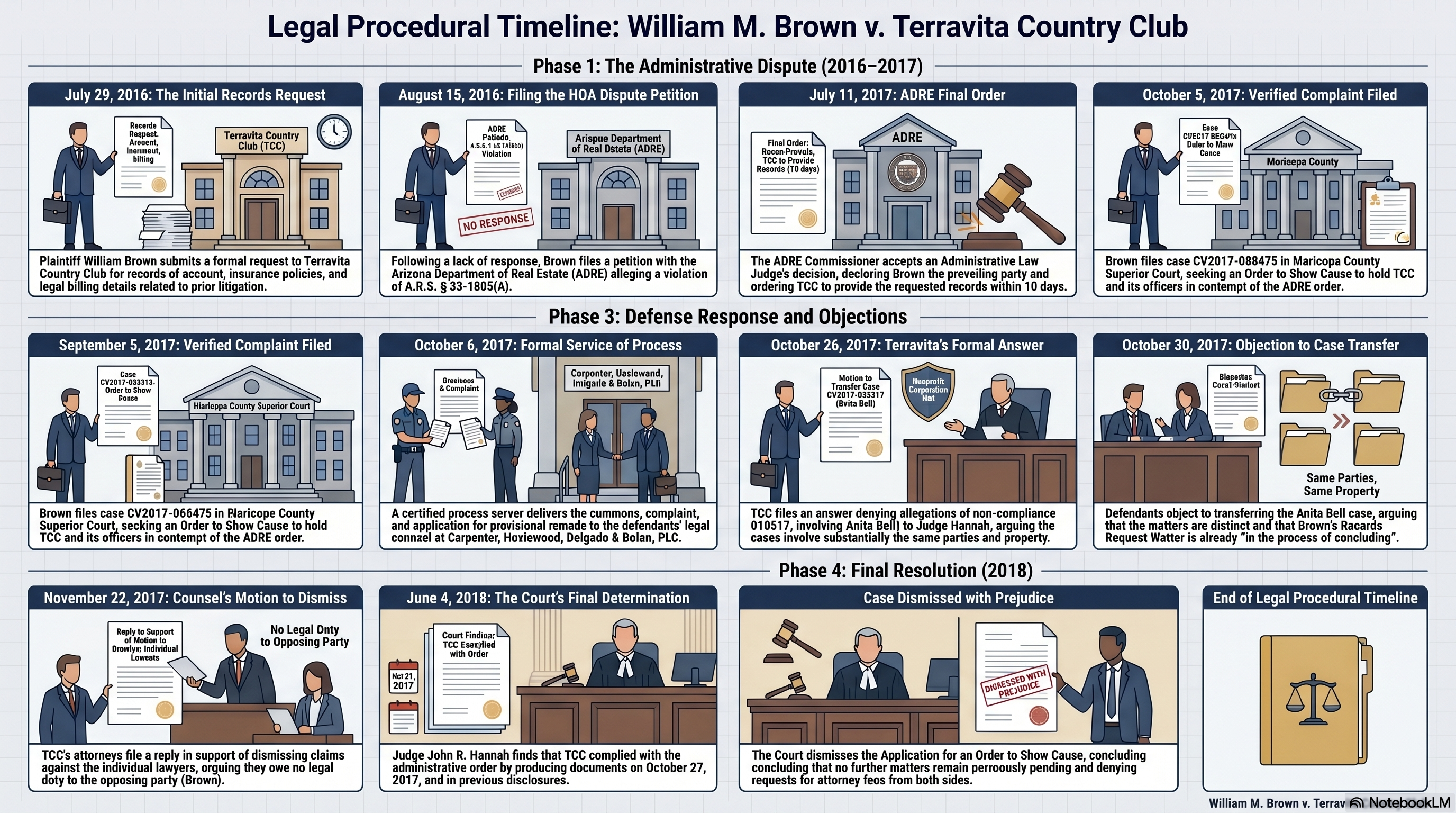
AI Generated Case Timeline Graphic
Type: Source image/graphic
AI-generated review material from the upload. Use it only for orientation; verify any legal claim against the linked court filings and orders.
Frequently asked questions
Did Brown win this Superior Court case?
No. The June 4, 2018 minute entry found Terravita had complied with the administrative order and dismissed the application for an order to show cause with prejudice.
Did Brown win the related administrative records cases?
Yes. The related OAH/ADRE records matters 17F-H1716005-REL and 17F-H1717032-REL were homeowner wins under A.R.S. § 33-1805.
Why were the individual directors dismissed?
The court ruled that fiduciary duties of HOA directors are owed to the HOA, not directly to an individual member such as Brown.
Why were the attorney defendants dismissed?
The court ruled the complaint did not state a claim against the law firm or lawyers and noted that lawyers ordinarily owe no duty to an opposing party.
Did the association recover attorney fees?
No. The court denied the defendants’ request for attorney fees and costs even though it dismissed the application, noting the timing of some responsive document production.
Primary sources
- Final minute entry, June 4, 2018
- Verified complaint and application for order to show cause
- Order narrowing the records issue, October 27, 2017
- A.R.S. § 33-1805 – Association financial and other records
- A.R.S. § 33-1803 – Assessment limitation; penalties; notice to member of violation
- A.R.S. § 12-341 – Recovery of costs
- A.R.S. § 12-341.01 – Recovery of attorney fees